Tuesday, November 19, 2013

TREAT.


Starring:
Grigsby the French Bulldog
Grigsby’s Owner
. . . & Dan Gutstein as Himself

Director:
Dan Gutstein

Running Time:
35 seconds

Advance Praise:
“Crunchy!” --Film Flam
“Munchy!” --Flick of the Ritz
“Chippy!” --Cinomatopoeia  
                      
Awards:
Best Chip-Eye View in a Comedy Short
Best Supporting Woofer in a Comedy Short
Best Snacking (Ever!) in a Comedy Short

Thanks To:
Grigsby
Grigsby’s Owner
Utz Gourmet Medley
Everyone I know!
The Power of the TREAT

If You’ve Indulged in Too Many Treats:

TEN TIPS FOR A SUCCESSFUL MIDDLE DISTANCE RUN.

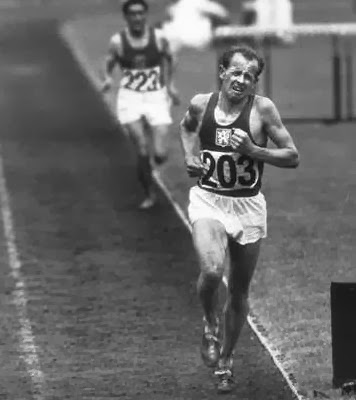
The great runner, Emil Zátopek—also famous for his grimace!


I am a runner in the sense that I haven’t taken a substantial break in 10 years (even on trips abroad) but I do not post world class results. Recently, I ran a 10 miler in 75 minutes, and a half-marathon in 105 minutes, both of which are brisk for me, especially as I am hobbled by this and that injury, but again, these results would not garner me any ribbons, including Le Riband Bleu that has eluded me all my life. About a year ago, however, I switched from running short distance during the week and middle distance during the weekend to running almost exclusively middle distance every time I lace up me jogging boots. It was the solution to my Mid Life Crisis—to run Middle Distance, like, all the time. I would define ‘middle distance’ as seven to 13 miles, but there may be a standard definition out there, somewhere, idling on a beach eating lobster claw. Friends have been asking me recently about (1) running in the abstract and (2) tips involving other matters so I am going to (3) cherry pick, and combine (running + tips) to offer unsolicited advice about how to accomplish a successful run in the Middle Digits. Here goes.

10. The Proper Boot. You should employ a shoe that matches the architecture of your foot. A running shop can help you select Fashion Colors. But I “pshaw” the notion that you must change boots at 400 miles. I ran about 800 miles on the Gel Foundation before Asics combined it and the Gel Evolution into a worthless hunk of wood. My new boot, the Saucony Progrid Stabil, rocks.  

9. Afternoon vs. Morning. I say afternoon. I’ve been up for a while, I’m warm, I’ve vented, I’ve harangued, I’ve centered the eyes, so to speak. If it’s hot, so be it, I don’t think that running in the heat is so terrible. In any event, the world is warming. Better get accustomed to it, I say. Either way, I wouldn’t go middle distance running after some sort of XXL bowl of porridge.   

8. Stretching. I don’t think there is any definitive evidence that proves the benefits of stretching before a run. It may work for some, and not for others. To me, stretching has always been better after a run, and then I stretch my whole body: ribcage, hammies, and eight other districts. I’d say stretch the way you manage your checkbook: don’t bounce. Hold for 30 to 60 seconds apiece.

7. The First Three-Tenths of a Mile. I jog slowly for the first two-tenths of a mile, then I walk for a tenth of a mile, before I launch into the run. The warm-up period helps the legs (and upper body) approximate the motions and the rhythms. No two rhythms are the same, I have found. Every run is like being on a new date: one is painful, one is great, and one goes on in the dark.

6. Intervals. I practice intervals all the time. Even though D.C. has parks, with uninterrupted stretches, I must sprint to beat lights or to pass other runners (“…suckerrrrr…”) or for no reason at all but to confuse my muscles. Sprint for a while and rest by running slower, never stopping. The problem is, it carries over into other arenas: typing really fast, then slow, as a blogger.

5. Hills and Staircases. Sprint the (outdoor) staircases, and also uphill, but take it slow going downhill. I see many runners charging downhill and I worry for pulled hammies. Not to mention wild, out of control, wind-milling arms where the runners wind up splashing down into the creek. It must be terrifying and beautiful, alike, to lose control, but focus on the terrifying—and avoid.

4. If Tired. Run like Wilfried Bony, a recent transfer to my football club, Swansea City. Wilfried runs deliberately, powerfully. Slow isn’t the word but muscular is. He turns on the speed when necessary. He conserves. He projects significance. Wilfried rumbling toward goal: look out! “Wilfried” as opposed to Bony (pronounced “bonny”) because, just because, he’s Wilfried.


Wilfried in his Swansea home kit. Up the Swans!


3. Weight Training and Cross Training. I believe in both, especially weight training. I do a basic 20 minute workout three or four times per week: biceps, traps, delts, lats, triceps, abs, pecs. At times I have swum (yes, I have) and I have biked (yes, I have). My latest thing is long walks. My latest thing is long walks where the destination may be pumpernickel, stout, kalamata, or coffee.

2. Dealing with Pain and Injuries. I believe in pushing through pain, so long as there is no crunching noise, no gristle noise. If you ignore gristle noise, you could turn into a gristly bear. Currently, I have six injuries: right foot, right ankle, left knee, right thigh, left chest, right giblet. I do, however, sit my hammies on a heating pad after every run to keep ‘em nice ‘n’ warm.

1. Frequency. It’s not advisable to run seven days out of seven on a middle-distance regimen, and I would not advise more than three days in a row. On your days off, cross-train. Eat a meatloaf sandwich or a quinoa pilaf. Go to the cinema with a beer in your backpack. Defend the world against mediocrity. As part of that defense, oh yeah, run them middle distance miles!

If you have completed a middle distance run, then you deserve a TREAT.

Wednesday, November 13, 2013

WHEN A FLORA EATS A FAUNA.

Run, fauna, while you still can!


A flora develops carnivorous knowledge, and it spreads, this knowledge, in hedgerows and alpine forests and scrub formations throughout the land, a fauna disappearing here and there—a real head-scratcher to the schools, bales, coveys, clutches, packs, prides, tribes, colonies, sleuths, and bloats, until one flora, one day, entraps a fauna in public, on the side of the road: the fauna, sitting there, in the flora’s gullet, thinking, “Aw, man, what’ll happen to my radical politics now?” Other fauna stand at a distance from the victim, who nods at them in country manner. “Well, this explains everything,” says one in the crowd. “Not everything,” says another. “It doesn’t explain Wal-Mart, Wall Street, and Kmart, and it hardly explains the general misallocation of resources.” Another in the crowd addresses the victim: “What’s it like in there?” The victim replies, “Itchy.” A second questioner says, “Itchy or ticklish?” The victim says, “It’s making me sneeze. I think I’m allergic to being digested.” The sun sets and the sun rises. Some of the fauna drift off to eat a flora, in the hopes that the predatory flora would change its mind and release their kin-fauna, while others drift off to eat other fauna. The sun sets and the sun rises. Now but a few fauna maintain a vigil at the site of the entrapment. They kindle candles, they chant verses, they clutch teddy bears. “How’s it going?” one of the vigilant asks the victim. “Not bad,” says the victim. “Basically, I’m content. I feel like I can be digested and move on with my life.” Another of the vigilant asks, “Are you stuck? You look a little stuck.” The victim thinks this over. “I am experiencing very, very slow peristalsis, whatever that means. So, yeah. I think I’m stuck.” The sun sets and the sun rises. None of the fauna remain at the site of the entrapment, leaving behind all the materials of their vigil: hollowed out candles; heaps of department store bears; and a jumble of Starbucks take-out cups, raw sugar packets, and wooden stirs. “I guess this is it,” the victim thinks. “Not all herbs are herbivores. It gets so—you want to tax everything and hide in the cellar. It’s a cellar’s market, after all.” He thinks no more. He becomes, for a moment, the flora’s ornament: apple-headed, stubborn, and frozen in mild recognition of some great folly, before the flora, sort of, introduces the fauna into the very fiber of its fiber, acquiring in the digested fauna the essential fears and contradictions of its faunal kingdom, while around the flora wheels a watery wind that will nourish the vegetation in its growing polemic—a brash, wasteful imperialism that startles the very purity of the floral roots.

Thursday, November 7, 2013

THERE WOULD NOT BE A TEAM DUBBED THE WHITE-SKINS (RIGHT?) SO THE WASHINGTON REDSKINS FRANCHISE MUST CHANGE ITS NAME.

 The football version of ‘Cowboys and Indians’


(1)

On a recent car ride, my brother and I tried to engage in conversation by calling each other “kike”, you know, to possess a word which is not, in all likelihood, being spoken by anyone anywhere. “Yo,” I may have said, “you’re a low-down, shiftless, ‘skonky’ kike!” It didn’t even work. He got amused by the word ‘shiftless’ and we entered into secondary hysterics. Some slurs, I imagine, will always enrage the object of a name-calling session while other names, to be insulting, depend upon the context. I doubt that a stranger, in any event, could utter the word ‘redskin’ to a Native American without causing offense. Would a white man (a white-skin) walk over to a person of color and greet him as ‘brown-skin’? There are many African Americans who play football for the Washington Redskins. I can’t imagine that any of them would tolerate the word ‘black-skin’ if spoken to them or emblazoned, for example, on a game-day program.

(2)

The Washington Bullets basketball team changed its name in 1997, in large part to disconnect itself from the soaring murder rate in the city proper. That’s to be applauded, except that the replacement name, the Washington Wizards, is terrible. It’s not intimidating; it shortens to The Wiz (or The Whiz); and it offers forgettable options for logos, mascots, branding, et cetera. Nobody would suggest that the Redskins franchise should change its name haphazardly, but at the same time, numerous options present themselves. The Bullets might have transformed themselves into the Sea Dogs, a name reputedly mentioned as a finalist for the switch. Who were these Sea Dogs but English pirates who operated in the Caribbean, and by naming a team the Sea Dogs, I doubt that any pirates, seas, or dogs would take offense. It shortens to “dogs” (“Who let the dogs out? Who? Who? Who?”) and fits with other franchise names that refer to marauders.

(3)

That said, let’s take a quick look at the 32 current franchise names in the National Football League, broken into four categories:

Animals with Local, National, or General Significance
Arizona Cardinals
Atlanta Falcons
Baltimore Ravens
Carolina Panthers
Chicago Bears
Cincinnati Bengals
Denver Broncos
Detroit Lions
Indianapolis Colts
Jacksonville Jaguars
Miami Dolphins
Philadelphia Eagles
Seattle Seahawks
St. Louis Rams


Lions and Bears mauling each other but not slurring a group of people


Figures from American History, Industry, and Lore
Buffalo Bills
Cleveland Browns
Dallas Cowboys
Green Bay Packers
Houston Texans
New England Patriots
New Orleans Saints
New York Jets
Pittsburgh Steelers
San Diego Chargers
San Francisco 49ers

Mythological Beings and Marauders from World History
Minnesota Vikings
New York Giants
Oakland Raiders
Tampa Bay Buccaneers
Tennessee Titans

Native American Imagery
Kansas City Chiefs
Washington Redskins

I cannot vouch for the wholesomeness of every team name listed here (bears have surely mauled and eaten lots of people, probably even some Native Americans) but on the surface, 30 of these 32 names do not slur an entire group, and the 31st name, the Chiefs, at least conjures leadership as opposed to skin color. It, too, has been the subject of protest from Native American groups. On some level, it defies understanding why the Kansas City and Washington franchises cling to their names, given the many other kinds of names employed (and branded) successfully by other franchises.

(4)

In its (bumbling) defense the Washington Redskins leadership cries about the “horrors of rebranding” and the “loss of tradition.” Let me pause to laugh a little bit. In the tenure of the current owner, Daniel Snyder, the team has changed coaches and quarterbacks so often, without much in the way of results, that there is, at present, very little tradition of winning, and frankly, rebranding could be just the thing to generate excitement in the club. At any rate, Snyder earned a lot of his money through direct advertising—so the apparent horrors of rebranding escape me. We’re not talking billions, at any rate. Snyder only has a few of those. No, we’re talking millions, which Snyder has lots of, lots and lots of millions does Mr. Daniel Snyder have, yes.

(5)

Simply put: if Daniel Snyder, owner, cannot walk up to a Native American and say, “Hey, how’s it going, redskin?” then the team name Washington Redskins cannot and should not be on TV every week.

Monday, October 28, 2013

PUSH UPS


Cast
Pusher Upper
Blurry Sitter

Director
Dan Gutstein

Running Time
47 seconds

Advance Praise
“A call to arms . . . and pecs.” —Flix

“Pectoral. Pictorial.” —Flex

“The lummox in flummox.” —Flux

Awards
Best Crotch Grab in a Silent Short

Best Front Stance in a Silent Short

Official Selection: Airport Station Film Festival

Thanks To
Everybody I know!

Windows.

Platforms.

Spontaneous workouts!

Commutiz. 

Tuesday, October 22, 2013

MASH-UP MAYHEM: INVESTIGATING A PHENOMENAL EXCHANGE OF WORDPLAY BEGUN WITH “TAE BO DIDDLEY”.

Mr. Potato Head & Shoulders: Shampoo for Your Flaky Spud?


A few nights ago, amid quiet contemplation at home, I decided to post a “mash-up” on Facebook, in the hopes of eliciting a little wordplay competition from a friend or two. A similar post (“For Whom the Taco Bell Tolls”) a couple years ago had yielded some spirited commentary (my friend John McNally famously wrote, “Burger King Lear”, among many replies from many people) and I hoped for some of the same this time, by posting “Tae Bo Diddley.” Three people would join me to produce the bulk of a truly exceptional, stunning thread: the writers Joel Dias-Porter and Heather Fuller, and a former student of mine, Prithvi Jagganath, who proved his own mettle in devising many memorable mash-ups. In these moments, I do appreciate the Internet, as I haven’t seen Joel or Prithvi in person, in quite a while. A few days earlier, Joel had begun an “add a word, ruin a movie title” thread on his Facebook page, which drew many howlers from him and his friends. I took pride in my two contributions there—“An American in Paris Hilton” and “Gunfight at the Ofay Corral”—and therefore appreciated it when Joel conferred crucial early momentum upon “Tae Bo Diddley”, offering several comments, including “Doug E. Fresh Fields.” In the end, six people participated, by making 140 comments over approximately four hours. There were no rules but it was generally understood that we would rely upon celebrity names, book titles, catchphrase, place names, Americana, and institutional titles (e.g., corporate branding) for the bulk of our material. Some comments would influence those that followed. Some made me laugh aloud. Virtually all of them bore new meaning. By the end, this improvisation showcased a number of nuanced forms worthy of classification, to the extent possible, and brief review.

1. A B + B C = A B C. Perhaps the most common form of this wordplay mash-up, it relies upon two entities that share a common word or title. Examples: “Harrison Ford Taurus” (Prithvi) and “Weird Al Capone” (Heather).

2. Extension. This variation on the A B + B C continues the mash-up for another cycle, adding, in effect, a C D. Example: “Elizabeth Taylor Swift Boat” (Joel). This particular example starts with an actress, veers through a pop country music star, and ends with a controversial political attack, a feature of the 2004 American presidential race. In the end, the wronging of John Kerry can be laid at the feet of Elizabeth Taylor. Or perhaps the very craft bore her name.

3. Long Extension. Last year, I wrote a blogpost with the title “Midnight in the Olive Garden of Good and Evel Knievel,” which plays on a book title, a chain restaurant, and an American daredevil stunt man. It does not strictly follow, however, the A B + B C format, which we largely observed on Facebook. Example: “Rita Dove Soap Powder Keg of Beer Bellies” (Joel). If you slow down and read it, block by block, it’s an incredibly compact, fitting phrase, taking you, by way of addition, from the former Poet Laureate all the way to paunches borne of the suds.

4. Word within a Word. As opposed to the clean A B + B C, this form relies upon the reader discovering a word within a word in order to complete the mash-up. Examples: “Amelia Earhart attack” (Prithvi) and “Biscuit Carson” (Heather). In the latter, “Biscuit” stands alone but also presents a punning path to complete “Kit Carson.” Perhaps biscuits were the frontiersman’s favorite carbohydrate.

5. Front Loaded. In this example, the first half of the mash-up dominates the phrase, and at the same time, may employ the Word within a Word concept. Examples: “The Marlboro Manhattan” (Joel) and “The Girl with the Dragon Tattoo You” (Dan). This form, in particular, can create some sprinting and halting rhythmic possibilities.  

6. Acronym. In opposition to the Front Loaded example above, this form seems to create a slower clop at first, with more speed as the mash-up completes. Examples: “ROFL LMAO Tse-Tung” (Prithvi) and “KFC Everett Koop” (Dan).

7. Replacement-phone. This form relies on the reader’s ability to substitute a “homophone”, i.e., a same-sounding word, in order to complete the mash-up. Example: “50 Cent of a Woman” (Prithvi). The rapper 50 Cent begins the mash-up, but the reader must supply “Scent” for the film title, Scent of a Woman. The magic, of course, resides in the secondary meaning(s)—a beggar’s plaintive plea? or half of a woman made of a dollar? (or a larger amount?) etc. Oy!

8. Pun. To some extent, all of this was punning, but some of the replies further referred to the subject’s primary orientation. Example: “Kierkegaarden of Eden” (Dan). As a Christian philosopher, Kierkegaard may well have advocated a belief in the ‘fundamental households’ of faith—as a sign of spiritual health. What better household than Adam and Eve’s crib?

9. Self-Reference. It’s important to say who you are. Example: “HillBilly Joel Dias-Porter.” However you may see yourself, it’s still rock ‘n’ roll to me.

10. Complete Transformation. Enter “Remember the a la mode” (English III; his only comment on this thread) and “Pussy Galore’n Greene” (Heather). The latter mixes a 007 villainess with Lorne Greene, of Bonanza and Battlestar Galactica fame, in effect establishing a two-headed, transgender, double-agent space commander of sorts. The former ended the entire thread: a simultaneous forlorn farewell to old strongholds with a side scoop of ice cream melting on the battlements.

Thursday, October 10, 2013

FORGET CIVILITY: 10 TIPS ON HOW TO SURVIVE A MELEE, A BRAWL, A SCRUM, OR A RUCKUS.

Looks like pretty good cardio.


10. Attempt to Defuse. Most melees benefit from a spark, a ‘drunken escalation’ that cooler heads could smother. If one of the belligerents, for example, asserts “Your friend has a beef with my brother” then offer to buy the brother (and the belligerent) some beef, preferably some burgers on 2-for-1 night. Think of the health benefits—no broken bones!—of chopped steak in a bun!

9. Stay Put. If a scrum or ruck breaks out, don’t move. The reason being: everyone in a ruckus reacts and then they experience damage to life, limb, or property. Imagine a zen-like stance in which all the bar stools, bowling pins, dip cans, beer slicks, monopoly pieces, hairbrushes, ashcans, Grecian urns, French-fried potatoes, invective, and rubber snakes crash around you.

8. Forget Civility. Contrary to what you might think, you do not enjoy protection under the Geneva Convention, among other treaties. You cannot become a prisoner of war in a brawl since it places an undue administrative burden on the other side. Calling the cops would only add a third side to the conflict, a side notorious for taking everybody, regardless of justice, as prisoner.

7. Suggested Tactics. The Consultant-in-Scrums to Blood And Gutstein (Anonymous, Marine Corps, Ret.) offers one word: Epiglottis. Disable the epiglottis and the opponent will tumble. Of course, in a scrum, you might need to disable several epiglottises. We also advise pinches, eye-pokes, tickles, nose-pulls, wallet-grabs, and sycophantism: basically the Three Stooges playbook.

6. If Those Don’t Work. Go crazy. Scream like a wildebeest. Beat your bosom and lash out in all directions, even if that means walloping a friend. Chances are that friend did something to wrong you at some point and deserves a clatter. There you are, going crazy, and what? The melee ceases. Everybody has grabbed hold of everybody else, but paused, staring at you going nuts.

5. If You Detect a Foreign Language. Beware words like “Fook” and “Feck” as they may indicate the beginnings of a considerable ruckus. Listen carefully for other clues. If, for example, you hear the thumpety-thump of darts into a dartboard then the words “Fook” and “Feck” should not be feared, and at worst, may indicate the misfortune of a shanked treble.

4. Consider the Landscape. If a brawl erupts at the ocean, you have one fewer direction in which to run. The waves are there to toss you back toward the rumble, and so you really can’t swim away. Potentially, the entire rumble could transpire in the surf, which might attract the attention of sharks. (Jets, too.) Shark-human alliances are rare; sharks usually devour all the combatants.

3. Nursing Physical Wounds. Click over to Google Wounds to get a real-time view of the contusions you sustained in a scrum. It’s a helpful app. You can also get directions to the original site of your wounds, estimate the time it’ll take to heal your wounds, and rate your wounds—you know, give them, like, four bandages out of five. Otherwise, apply plasters and lean meats.

2. Nursing Psychic Wounds. We at Blood And Gutstein realize that there are wounds, and there is trauma. Let’s talk trauma. We mean the invisible mark of a melee that endures—like the stranded Cosmonaut—in the dark vacuum of your soul. Or maybe that’s just the odor of really bad beer that even the old Arm & Hammer can’t manage to cleanse from shirt and trouser alike.

1. Should You Attend Your 25 Year Melee Reunion? We think you should. You get to see how things have turned out for everyone in the melee. Well, everyone who’s not incarcerated. People have put on weight. Started families. Self-radicalized their politics. Of course, there’s always the risk of another brawl, but isn’t that just part of the essential tension that informs our lives?

This post dedicated to Terence Winch.