1. I’ve been seeing this hawk up in the greenery, no not
that greenery, I mean the greenery! For months. Here, she fluttered down to engage
in some scrutiny with me, her only human friend. It was a lengthy, calm, formal
visit. I spoke English. She listened. That is our dynamic.
2. This is my favorite deer. “You’re a good-looking deer,” I
tell her. Now, before you wicked people start with your quips, I am already
involved with a fox. The other deer are like bounding here, bounding there. Whatevs.
I need dependability in a deer. Like a newspaper: she’s waiting, daily.
3. Behold the mole kingsnake! I nearly jogged on this fella.
It’s a perfectly good snake, only you don’t lay eyes on it very often, so you’re
like “copperhead?” but no, that’s not a copperhead. To be clear, I don’t like
snakes: most of them can go f*** off. But I like this one.
4. Here we see a renegade member of Brood X reclining
comfortably on a stalk of grass. I remember when everybody was like “Where’s Brood
X?” blah blah blah (impatiently) but not anymore. Cicadas everywhere: mating on
my car tires, ffs. Good thing I’ve got all-weather radials.
5. The Fox in My Life. (a) She jumps the creek but looks
back to see where I am. (b) She appears suddenly in the grassy grassy lea. (c)
She jogs with me at a remove, on the edge of the woods. (d) She checks on me in
the snow, after I had slipped! (e) This is just heartbreaking, I will confess.
Here she is, waiting for me, sitting as a dog might sit. I have been pandemic-isolated
from so many people and places but this fox has been my friend.
When the self-taught guitarist Joshua Barnes Howell played the
blues, it came from a place of multiple hardships and irregular pursuits. Born
in 1888 to a farming family in rural Georgia, Mr. Howell worked as a farmer himself
until an argument led his brother in-law to shoot him in the leg, forcing its
amputation, and generating the man’s unanticipated nickname. No longer able to labor
on the farm, “Peg Leg” Howell drifted to Atlanta in the early 1920s, where he
began busking and bootlegging. After a one-year stint in jail for a
moonshine-related offense, he was discovered playing some raucous licks with a
group of musicians on Decatur Street.
Columbia Records wound up recording Peg Leg Howell solo, as
well as in an ensemble known as Peg Leg Howell and His Gang. The latter
featured the bust-out greasy electricity of fiddler Eddie Anthony and the
steady second guitar of Henry Williams. In all, Howell cut about two-dozen
sides for Columbia between 1926 and 1929, and was noteworthy for being one of
the first African American country blues musicians to record his music. The
Great Depression deprived him of further recording opportunities but he
continued to play in Atlanta. When the fiddler Eddie Anthony passed away in the
mid-1930s, Howell retreated into obscurity, only to be rediscovered by a
folklorist about three decades later. By then, Howell was an impoverished double
amputee, owing to “sugar diabetes.” He recorded an album’s worth of material
(released on the Testament label) before passing away in 1966.
Howell’s first recording session in 1926 (solo vocals and guitar)
generated a song—“New Prison Blues”—that merits placement alongside the great
murder ballads, including Son House’s “Death Letter Blues” and Mississippi John
Hurt’s “Stack O’Lee Blues.” Howell and His Gang (together) conquered a variety
of idioms including string band, jazz, and dance numbers; the peppy 1927
“Beaver Slide Rag” might be just the song that’d make you reach for the corn
liquor. Springing-forth from that vein, but omitting guitarist Williams, we
present for your devotion the magnificent 1928 tune “Turkey Buzzard Blues,”
which thoroughly douses itself in suggestive language and never stops jumping. We
can only imagine how Eddie Anthony didn’t saw his fiddle in half during
the session that produced this gem.
(L) Williams; (C) Anthony; (R) Howell
Our Musicology Department has been working overtime on this
song and we’re proud to present the lyrics, below. “Turkey Buzzard Blues” may
borrow some floating verses from traditional sources and also refers to another
country song, “Sugar in the Gourd.” Moreover, it’s the only song not about
chinquapin hunting that mentions chinquapin hunting. I’ll save you the
trouble of looking the word up: the chinquapin is a “dwarf chestnut” tree or
shrubbery of the southern regions that provides fruit, shade, and cover to
people and animals alike. Indeed, someone (a cute little poor gal) could’ve
climbed into a chinquapin tree, fell down, and the other person—who happened to
be a peg-legged singer—could’ve seen “sump’in.” Go have a listen to Peg Leg and
Eddie swinging the dickens out of the universe.
“Turkey Buzzard Blues” Peg Leg Howell and Eddie Anthony Peg Leg Howell (guitar, vocals); Eddie Anthony (fiddle,
vocals) Columbia Records 14382-D (Atlanta, Ga., 1928) 10-inch B-side
b/w “Banjo Blues”
Had a long gal, she was tall and thin Had a long gal, she was tall and thin Had a long gal, tall and thin Every time she jigs (I said) “do it up again!”
If you got six bits (you) think you want to spend Got six bits, think you want to spend Got six bits, think you want to spend Go around the corner and cop it till it win
Now me and my gal went chinquapin huntin’ Me and my gal went a-chinquapin huntin’ Me and my gal went a-chinquapin huntin’ She fell down and I saw sump’in!
Have you ever went fishing on a bright sunny day? Standin’ on the bank, see the little fish play Hands in your pockets, in your pockets, in your pants See the little bitty fish do the hoochie coochie dance!
Had an old hen and had a peg leg Fattest old hen that ever laid a egg It laid more eggs than the hens around the barn Another little drink wouldn’t do me no harm
There’s sugar in the gourd, can’t get it out Sugar in the gourd, can’t get it out Sugar in the gourd, can’t get it out Now the way to get sugar, gotta roll it all about
sources of information
AllMusic Guide biography for
Peg Leg Howell Charters, Samuel Barclay. Country
Blues. (Da Capo Press, 1975). DAHR discography
for Peg Leg Howell Early Blues article about “Beaver Slide Rag” Oakley, Giles. The Devil's Music. (Da Capo Press,
1997). Oliver, Paul. Songsters
and Saints. (Cambridge University Press, 1984). Old Time Blues article on early recordings of Peg Leg Howell Oliver, Paul. The story
of the blues. (Chilton, 1969). WayBack Machine article on Peg Leg Howell Wikipedia article on
Castanea Pumila (Chinquapin tree) Wikipedia article on Peg Leg
Howell WIRZ discography
for Peg Leg Howell
In April 1924, Aunt Samantha Bumgarner and her collaborator
Eva Davis became the first women to record country music. At the same time, Bumgarner
and Davis became the first people to record five-string banjo. Summoned
by Columbia Records, the duo traveled from the mountains of western North
Carolina to New York, where they cut several sides together, and some solo
sides apiece. Neither artist would record again. While Davis refrained from
performances afterwards, Bumgarner established herself as one of the most influential
country musicians—fiddler, banjoist, singer—of her generation. She
passed away in 1960. Born circa 1878 (or 1880) to a musically-inclined family, Bumgarner
(neé Biddix) nevertheless faced resistance when demonstrating an interest in
playing instruments. Her father finally allowed her to play a homemade banjo—a
gourd with a cat’s hide stretched over it and strings made of cotton thread slathered
in beeswax—before purchasing her a “10 cent” store banjo. Later, her husband Carse
bought her the first “devil’s box” (or fiddle) she ever owned. While her
ambitions may have challenged the “appropriateness of gender roles” at the time
(that is: only a man can fiddle Appalachian mountain music) it was probably
obvious that she possessed what the kids would call “mad talent.” Bumgarner
defeated many a male banjo player in winning contest after contest. Given the respectful musician title “Aunt” at age 30, Bumgarner
would become a regular at Bascom Lamar Lunsford’s Mountain Dance and Folk Festival.
It was there that a young student, Pete Seeger, was inspired by Aunt Samantha
Bumgarner and her five-string clawhammer banjo technique. In 1939, Lunsford,
Bumgarner, and others appeared at a command
performance for King George VI and Queen Elizabeth, hosted by President
Franklin D. Roosevelt and his wife Eleanor. It’s funny to imagine English
royalty sitting there, squirming stoically, while Aunt Samantha Bumgarner might’ve
torn through a North Carolina dance number like “Big-Eyed Rabbit.”
Our Musicology Department has been working overtime on this
song and we’re proud to present the lyrics, below. My goodness: where to start?
The whirling pace—and rough elegance—of Bumgarner’s fiddle? The cool, yet not
inelastic anchoring of Davis’ banjo? How could we not discuss the clipped,
frenetic vernacular of Bumgarner’s vocals? And what of the song’s story? That
beloved rascal the big-eyed rabbit. Howling hound dogs. Threat of the old shotgun.
The regular “lord, lord” invocation of a deity. The concept of “getting’ there
now” which is mighty ticklish, given the song’s dizzying pace. Clearly, many
people were “rocking” well in advance of rock ‘n’ roll. Would your life be
better if you turned this tune up loud and hopped around? Why yes it would.
“Big-Eyed Rabbit”
Samantha Bumgarner and Eva Davis Samantha Bumgarner (fiddle,
vocals); Eva Davis (banjo) Columbia Records
81710 129-D (New York, N.Y., 1924) 10-inch A-side b/w “Wild Bill Jones” [Notably,
“Wild Bill Jones” features only Davis.]
Rabbit oh rabbit done hear them hounds Yes lord lord they’re gettin’ me around Get there rabbit rabbit get there now Yes lord lord I’m gettin’ there now
Rabbit oh rabbit your ears mighty red Yes lord lord been jerkin’ [up afraid] Get there rabbit rabbit get there now Yes lord lord I’m gettin’ there now
You jump out and start to run Shoot you down with my old shotgun Get there rabbit rabbit get there now Yes lord lord I’m gettin’ there now
Rabbit oh rabbit your foot’s mighty round Yes lord lord make a hole in the ground Get there rabbit rabbit get there now Yes lord lord I’m gettin’ there now
Rabbit’s in the garden siftin’ sand ‘Fore tomorrow morning I’ll have him in my hand Get there rabbit rabbit get there now Yes lord lord I’m gettin’ there now
Rascal rascal hearin’ my dog Yes lord lord I want [a call] Get there rabbit rabbit get there now Yes lord lord I’m gettin’ there now
sources of information
Appalachian History (.net) article
on Samantha Bumgarner Banjo News article on
Samantha Bumgarner Birthplace of Country Music article
on “Big-Eyed Rabbit” Bluegrass Today article
on Samantha Bumgarner Bufwack, Mary A., and Oermann, Robert K. Finding
Her Voice: Women in Country Music, 1800-2000. (Country Music
Foundation Press, 2003.) Cloer, Tom. “Aunt Samantha
Bumgarner: Pioneer in Southern Music.” Pickens County Courier (July
10, 2013). DAHR discography
for Samantha Bumgarner DAHR discography
for Eva Davis Hotaling, Lynn. “Samantha
Bumgarner was a musical pioneer.” The Sylva Herald (May 1, 2019). Old Time Party article
on Samantha Bumgarner WIRZ discography
for Samantha Bumgarner Wolfe, Charles K. “Samantha Bumgarner: The Original Banjo
Pickin’ Girl.” Old Time Herald (Winter 1987-88), pp.6-9.
In 1926, a man named John L. “Uncle Bunt” Stephens recorded
an unforgettable tune—“Candy Girl”—as part of one-day recording stint at Columbia
Records in New York. He had drifted out of obscurity after he may have won (or
placed highly in) a series of fiddling contests sponsored by Henry Ford. We say
“may have won” because there may have been fewer contests than claimed, or rather
no contests at all. Uncle Bunt toured that year and made some notable appearances
before drifting back to the rural area of Tennessee where he lived with his
second wife. In the mid-1920s, Ford dealerships apparently sponsored
local fiddling contests. Uncle Bunt seems to have competed in these, placing
highly or triumphing. Then, according to legend, Uncle Bunt and other
highly-placing fiddlers traveled to Detroit in early 1926, where Henry Ford himself
held a supreme fiddling competition that Uncle Bunt claims to have won, by
playing “Old Hen Cackled” and “Sail Away Lady.” Furthermore, according to legend,
Ford presented the triumphant fiddler with a new car, a rich payday, and a new
suit; he also paid to have Uncle Bunt’s teeth fixed. A scholarly article appearing
in the Journal of the Society for American Music suggests that therein may lie more
fiction than fact. (We wonder if dental records could offer some conclusive
evidence.) A letter from Uncle Bunt to Ford dated August 20, 1926, refers
to the “blue ribbon” that Uncle Bunt had been awarded at Ford’s last old time
fiddling contest. It also inquires about the prospects of a Ford automobile
being made available for Uncle Bunt’s touring. At the very least, this would
seem to discredit the notion that Ford had awarded Stephens a car. There is no
record of a reply. However things may have transpired with the Ford Motor Company, Uncle
Bunt Stephens enjoyed some fame in 1926. He appeared at the WSN Barn Dance
(later renamed the Grand Ole Opry), on radio stations, and at performance venues
across the eastern half of the country. He traveled to New York, where he cut “Candy
Girl.” Columbia Records would make it Side 1, bundled with “Left in the Dark
Blues” as Side 2. Columbia also released “Louisburg Blues” b/w “Sail Away Lady.”
It’s possible that Uncle Bunt recorded two additional songs at the same session—“Jenny
in the Garden” and “Leather Breeches”—but if he did, these cuts were never released.
He recorded these songs on March 29, 1926; he would never record again.
Three days before the recording session, the New Britain
Herald (of Conn.) reported that “Uncle Bunt Stephens of Tullahoma, Tenn., who
won a Ford fiddling bee, is visiting town. He complains that in Nashville two
pairs of pants given him by Henry [Ford] were stolen and he had to pay $1.10
for a shave in Chicago.” Two forms of theft in the big city. Two good reasons
to ditch the dangers of densely populated regions for the less-manic tableaux of the countryside. Importantly, Uncle Bunt’s recordings have been included in
Harry Smith’s influential Anthology of American Folk Music as well as the
Harry Smith B-sides anthology. The author Allen Lowe also included Uncle
Bunt’s music as part of his impressive 30-CD anthology that accompanies his
recently released two volume set of books, “Turn Me Loose White Man,” in
which Lowe analyzes a wide swath of important American recordings. Uncle Bunt’s
four songs made quite an impression. To our ears, “Candy Girl” walks the line between brightness
and mournfulness. Call it beauty. The tune is triumphant, to be sure, yet it expresses
the powerful, grating sorrows that inform our systems of remorse. Columbia
billed this record as “mountain dance music” and we don’t disagree. It’s hard
to imagine folks sitting still, when encountering “Candy Girl” in performance. Of
course, we encountered “Candy Girl” while sitting still, and it gouged us. By “gouge”
we mean that it clobbered us with its inherent (priceless) weights. The tune played
perfectly in the pandemic ravaged world of 2021, as we imagine it played perfectly
just scant years after the Spanish Flu receded. John L. Stephens was born in Tennessee, orphaned at an early
age, and raised by an aunt. He was proficient on the harmonica as a boy, and
claimed to have bought a fiddle from a tramp; the fiddle was of German manufacture
and may have dated to 1699. While “Uncle” is a common title bestowed upon venerable
fiddlers, we can’t comment on the man’s full nickname. He didn’t play baseball,
and to our knowledge, he didn’t ram anything with his forehead. Uncle Bunt
Stephens passed away in 1951 at the age of 72. “Candy Girl” lives on. We hear
it and our eyes well-up, simply.
Brownsville Herald (Tex.) April 3, 1926
sources of
information AllMusic Guide page
for Uncle Bunt Stephens Discography of American Historical Recordings page
for Uncle bunt Stephens Paul M. Gifford, “Henry
Ford's Dance Revival and Fiddle Contests: Myth and Reality,” Journal of the
Society for American Music 4, n. 3 (Aug. 2010): 330-332 National Museum of American History page
for the “Candy Girl” New Britain Herald via Chronicling America (March 26,
1926) Don Roberson via Internet Archive Way Back Machine article
on Uncle Bunt Stephens Harry Smith Anthology
of American Folk Music at Smithsonian Folkways Harry Smith B-Sides anthology at Dust-to-Digital Ryan Thomson, The
Fiddler’s Almanac(1985) Wikipedia page for Uncle Bunt Stephens
A song so unrestrainable that the singer can only prevent
its escape for an agonizing eight seconds. “La-de-da apartments”—the kind described
by writer Toni Cade Bambara—all across the country—were soon jumping to “Out Of
This World,” which quickly rackets uphill.
The singer was / is “Jumpin’” Gino Washington. At the time,
he was a bad-ass teenager from Detroit. Kids today would insist upon calling
him a BAMF and we would not disagree. In fact, this BAMF is among us. We
congratulate him heartily for his greatly stomping contribution.
When the song first appeared, Cash Box predicted that
it would “take a quick trip to chartsville” and it did just that, spending five
weeks on the Billboard charts and peaking at #44, in March 1964. The backing
vocalists, The Rochelles, would later become Tony Orlando’s “Dawn.”
The bass player was not the Chuck Berry, but he was a
guy named Chuck Berry. He was part of a white band, The Atlantics, that backed the
three black singers. While groups like Rodney and the Blazers or Booker T and
the MGs come to mind, that era was not known for integrated bands.
A short while later, Mr. Washington was drafted into the Army,
and sent to Vietnam. When he returned in 1967, his career had vanished. Meanwhile, a
UK-based singer, Geno Washington, had stolen all but one letter of his name. This
“Geno” was also an American serviceman (Air Force). But enough of that.
Before he served in Vietnam, Gino Washington opened for the
Rolling Stones. He worked with the Primettes, who would go on to become the
Supremes. He released other hits, such as “Gino Is A Coward.” And to this blogger’s
approval, he was backed at some point by the Royaltones.
Returning to “Out Of This World”—it may borrow its opening saxophone
riff from “Mr. Twist,” an obscure 1962 shaker
by Tommy and the Twisters. The lyrics are barely discernible. The lead vocals
are sludgy and the backing vocals may be too enthusiastic in their gluey star-brightness.
The guitar solo searches for itself in the cloakroom. It
rifles through a lot of the coats, trying, perhaps, to thieve some taxicab
fare. And yet, “Out Of This World” is almost perfect. “Does this 45 have a B-side?”
you might ask. Why yes it does. Behold:
“Come Monkey With Me” employs “monkey” as verb, with double
entendre. Not only should you do the monkey with me, but you should fool
around with me, too. It enters the long list of monkey songs, the best of
which may be Dave Bartholomew’s “The Monkey Speaks His Mind.”
But we love “Come Monkey With Me” because it could’ve been
the A-side. There’s very little energy lost between these two singles. According
to the song, if the gal would come monkey with [me], the singer promises to
love her…ten-der-ly. Yeah right.
A friend of mine once pointed out that she liked “Mr. Five
by Five” (Jimmy Rushing) because his jump
blues voice had that gruffness, full of character, and she was right. For
some, Gino Washington might not compare to fellow Detroit crooners Jackie
Wilson and Little Willie John, but he does possess that roughened shouting
stuff. It’s A-one.
The Detroit Metro Times ranked “Out Of This World” as
the 19th greatest Detroit song ever, noting that The Atlantics (garage), the
Rochelles (doo wop?), and Gino Washington (soul) brought “the myriad threads of
Detroit music to a boiling point.” Yes. We agree.
When you consider the Detroit acts that that rank higher than him—Marvin
Gaye, The Stooges, John Lee Hooker, The Supremes, MC5, etc.—it’s quite a distinction.
Look a little bit farther down the list for Nathaniel Mayer’s “Village of Love.”
We almost chose that song for this post.
Likely personnel
for “Out Of This World” b/w “Come Monkey With Me” Gino Washington (lead vocals); The Rochelles: Telma Hopkins and Joyce Vincent (backing
vocals); The Atlantics: Jeff Williams (lead guitar), Jim Watkins (rhythm
guitar), Rick White (sax), Chuck Berry (bass), and Cliff Rosin (drums). Songwriting/arranging:
George “Gino” Washington. Released on Amon 90580 (1963) and Wand 147 (1964).
sources of
information AllMusic Guide entry
for Gino Washington Billboard charting details for
Gino Washington Black Cat Rockabilly Europe entry for Gino
Washington Cash BoxFebruary
1964 Detroit Metro Times ranking
of the best Detroit songs ever Discogs entry for The
Atlantics Discogs entry
for “Out Of This World” / “Come Monkey With Me” Wikipedia entry for Geno
Washington Wikipedia entry for Gino Washington Wikipedia entry for Tony Orlando
and Dawn
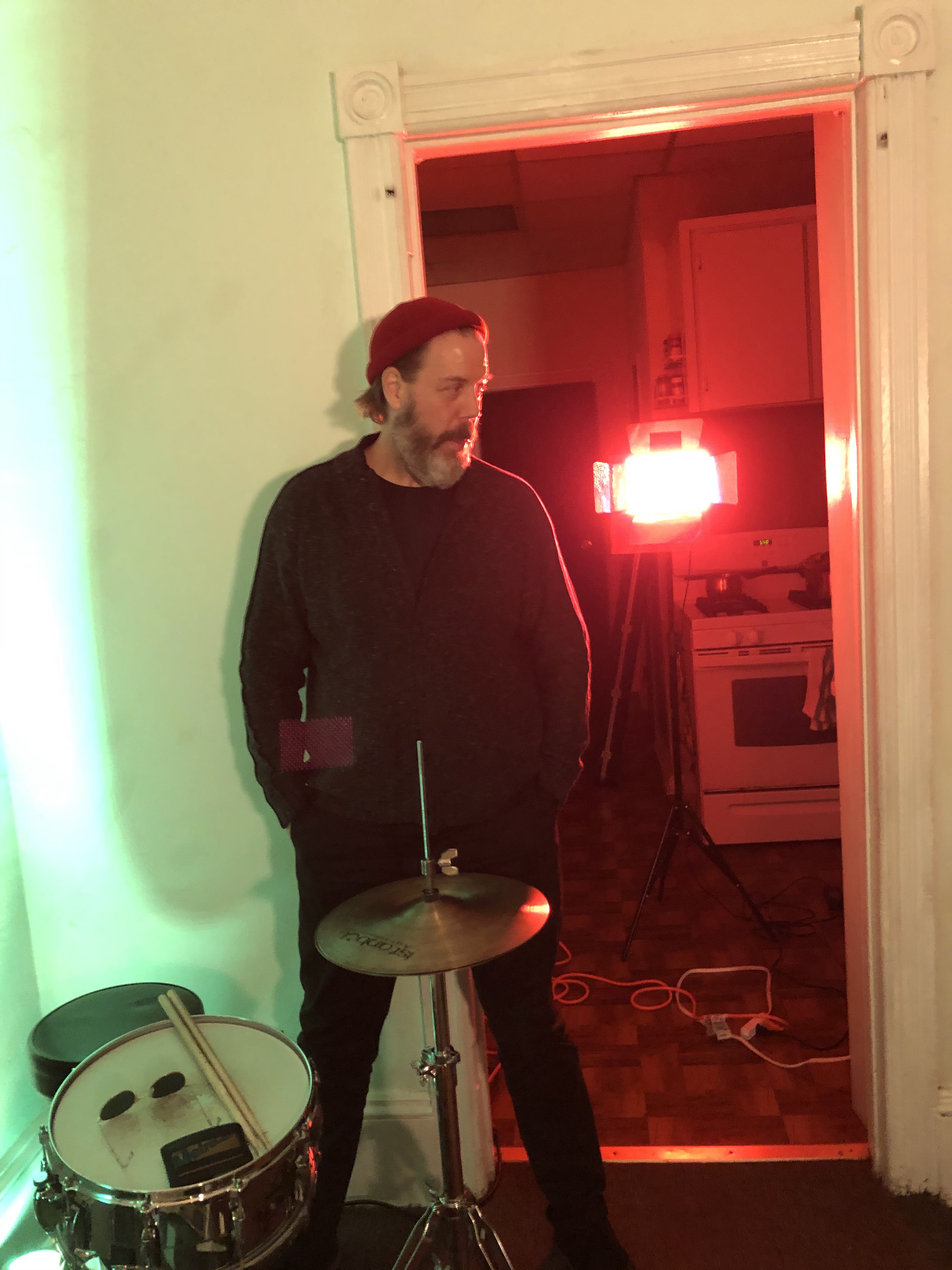
As I recall, the video shoot lasted from about 3 p.m. until
5 a.m. We got Chinese takeout somewhere in the middle. It was warm in November
(2019). It rained. By the morning, it was much cooler. The script called for
the official Joy on Fire cat, Funz, to participate at the very end. The fabulous
director, Damien Davis, asked us a famous question: “Will Funz cooperate?” (You’ll
have to watch the entire video to find out.) Damien and Chris work together;
it was Chris who recruited Damien for the video and the results speak for themselves.
“Thunderdome” debuted on NPR’s All Songs Considered, hosted by Bob
Boilen, Nov. 17, 2020.
Everything took place in John and Anna’s living room, in Trenton.
We assembled a collage. (Can you identify my two additions, Paul Celan and
Clarice Lispector?) I did my best work as a purveyor of Air Bass. All of us
wore sunglasses, except Anna, until the song’s final sequence, when she appears
(movie magic!) in shades. The music in “Thunderdome” never stops walloping. To
the best of my ability, I’d describe the lyrics as equal parts interpersonal
and societal outcry. “We Are Full of Anger and Decency.” Hasn’t that been
obvious, lately?
The final still photo is just a gratuitous pancakes image. It
was taken after Joy on Fire played a week earlier at Silvana, in Harlem. We wound up later
at the Seinfeld diner. So I did what anybody would do under those circumstances.
Sensibly, I ordered the blueberry flapjacks. Thanks for having a look, if you’ve
had a look, and thanks for any thumbs-ups, if you’ve given us any thumbs-ups.
It is our dream that Tina Turner will come across our video and have herself a
fine little chuckle. What’s love, but a second-hand emoticon?
key to the still
photos, in order: damien davis; chris olsen; john paul carillo, anna meadors,
and chris; john; the wall collage; anna, john, and chris; me and funz; chris; damien,
anna, and chris; me and pancakes.
this post is part of a
double-issue focused on joy on fire music videos. for a look at our anti-gun
protest video “uh huh” click [here].
John kept playing combinations of “dinn-dinn-dunn” on the bass
and I kept saying “uh huh” after every iteration. This was 2018, when he and I
first started adding words to music, in my old apartment up the hill, in Adams
Morgan, D.C., where you could see the Washington Monument from the living room
windows. The amp was thumping; the neighbors must’ve been going crazy. Were
there bottles of stout? Why, yes there were. “dunn-dinn-dunn!” // “uh huh!”
I said “uh huh” because I dug the bass line, but it became a
regular part of the song’s opening cycle, and eventually the title, too. A
change in the lyrics would appear after one of the song’s thumping, electrified
transformations. There, the words would speculate on the unknowable: the songs
not for the dead but of the dead. Ultimately, “Uh Huh” is an anti-gun
anthem. In it, we challenge murderers to atone, by returning the bodies (of
those they murdered) to the earth.
Importantly, other hands touched the song. Chris Olsen would
add the metrical necessity of drums. Anna Meadors added both dirgeful and
enraged saxophones; she also devised the refrain (the little loop of singing) at
the outro; she engineered the entire recording. In the fullness of time, Mark
Isaac and Gabriela Bulisova interpreted the song visually, through a combination
of thermal, rippling water, video game, marching, and corporeal imagery. It
seems quite accurate.
Even as Covid-19 has prevented us from performing, the video
has been gaining traction at several international film festivals. A special thanks
to our friends at the Oregon Short Film Festival, London Rocks Film Festival, L.A.
Rocks Film Festival, Brussels Independent Film Festival, Hollywood Verge Film
Awards, and Rome Independent Prisma Awards. Yo! With a dozen more submissions yet
to go! We didn’t have ginormous resources for a big push, thus the level of
interest has been especially surprising.
If you are inclined, travel to YouTube and give us a thumb’s
up. Give us an “uh huh.” Thanks.
this post is part of a
double-issue focused on joy on fire music videos. for behind the scenes at the “thunderdome”
video shoot, click [here].