A song speaks to us from nearly 60 years ago, one that
acknowledges gloom, to be sure, yet one that traffics amply in propulsion as
well. Too many songs don’t possess such crude sophistication; they’ll either veer
into tinny, tintype, saccharine testaments, or if not, they’ll sag into the
lower registers without any humor whatsoever. We’d otherwise weep into our specialty
cocktails (margarita + pineapple?) while the lightshow berates our questionable
decision-making. Thankfully, “Dark Valley” nourishes us with its worldly grit. It
may inherit some of this momentum from Bo Diddley’s classic freight train racket,
but we offer this last observation cautiously.
We know very little about this song. A man named Darrell
Tatum probably played lead guitar for the Holidays, a group that appeared most likely as a trio, who
recorded “Dark Valley” as an A-side b/w “Desperate” in 1961. Santo Records
released the two songs as catalogue No. 500—potentially its first release—in Memphis,
Tenn. Songwriting credit goes to Messieurs Alonzo Burris & Bruce Welch. Darrell
Tatum and the Holidays joined “the quicksand legions / of history,” to quote the
poet Richard Brautigan, and didn’t seem to record again together; Mr. Tatum may
have recorded two more songs as a solo act on the Fernwood label about four
years later, after which, he may have become
a guitar salesman. This is what we know, which is admittedly very little,
except to say that “Dark Valley” deserves an audience.
sources
of information 45cat entry
for Dark Valley Billboard magazine
July 3, 1961 Dead Wax blogpost on
Darrell Tatum Discogs entry
for Dark Valley Hillbilly Country blogpost
for Santo Records
prelude How did a self-deprecating African American comedy skit
about a drunk, who can’t convince his offstage roommate, Richard, to unlatch
the door, rocket all the way to the top of the charts in 1947? Well, I’m not
really qualified to answer that question, but when has that ever stopped me? The performative roots of “Open the Door, Richard!” may date back to
the nineteenth century, well before a fellow nicknamed McVoutie first converted
the routine into a novelty song, and before the phrase became a Civil Rights slogan.
The song influenced Bob Dylan and Allen Ginsberg, not to mention Yosemite Sam,
in the haunting ether prior to Bugs Bunny sending him off the high dive with
the crucial task of carrying an anvil all the way down.
the skit before the hit It would be unthinkable today for performers of any race to apply burnt cork
makeup and appear, insincerely or otherwise, in “blackface” routines. Yet during
another era, it wouldn’t have been uncommon to do so, for African American comedians
like Dewey “Pigmeat” Markham, John “Spider Bruce” Mason, and Clinton “Dusty”
Fletcher, all three of whom entertained audiences with “Open the Door, Richard!”
in a number of venues, including the waning minstrel circuit of the early
twentieth century. Their versions of the skit may have derived from Bob
Russell, a legendary writer whose career dated to the Civil War era.
Fletcher’s version may have been the most iconic; it was
filmed in 1945. Wearing shoes twice the natural length of his feet, Fletcher
plays a clown or buffoon character, evicted from a bar for the umpteenth time. Despite
pleading and knocking, he cannot rouse his roommate Richard to let him inside.
He’s a proud, spectacular mess for yet another offstage character, the
meddlesome woman across the street. He climbs a ladder, adding that he’s “high
as a Georgia pine,” but ultimately, he and the ladder clatter to the stage
floor. The audience chuckles. Over and over, Fletcher appeals to his roommate:
“Open the Door, Richard!”
While white audiences may have fathomed
some of the humor, the gags may have been particularly relevant to the African
American experience, through their references to squalor and shortages. The
drunk is wearing the only suit shared
by the two men, thus Richard must be at
home. The duo owe so much back rent that the landlady has asked for it over and
over again, but the drunk insists—never mind the back rent—she ain’t gonna get any front rent. Fletcher draws from the “dozens,” playground games, and
other oral tradition.
What was Richard doing, in there? Perhaps Richard had
been in a deep slumber, or perhaps he’d been entertaining a lady friend, but
either way, great power rests in his classical status as an unseen character.
In never speaking, in never appearing to unbolt the door, Richard’s absence
forces the monologue to keep unfolding, so long as the jokes continue to elicit
laughter.
enter jack mcvea
We like Jack McVea
because he played baritone sax on Lionel Hampton’s visionary jump tune “Flying
Home” in 1942, but also because Slim Gaillard dubbed him “McVoutie” during a
recording session with Charlie Parker. We enjoy saying McVoutie. (For this
reason, we like Slim Gaillard, too.) McVea knew the “Richard” skit quite well
as he often shared the stage with Dusty Fletcher, during tours. He affixed music
to Fletcher’s routine and began performing the song “Open the Door, Richard!”
as leader of his own band in the mid-1940s. During a 1946 recording session for
Black & White Records, the producer suggested that the group record the
song.
In this version,
McVoutie and his bandmates had been out “having a ball” but Richard went home
early, carrying with him the only key to their place. Thus, McVea preserves the
comedy skit’s tradition of highlighting shortages; namely, there is only one
key to go around, and apparently, several bandmates are living together in tight
quarters. The bandmates can hear Richard breathing in there, so why can’t he
come to the door? They knock again and again: “Open the Door, Richard / Open
the door and let me in.”
Officially, Jack McVea & His All Stars recorded “Open
the Door, Richard!” in Los Angeles. The September, 1946 session likely included
Tommy “The Crow” Kahn (piano), Gene Phillips (guitar), Frank Clarke (bass), and
Rabon Tarrant (drums). The lead vocal is handled by Jack McVea, with assistance
from Rabon Tarrant and Joe “Red” Kelly. Writing credit goes to McVea and
bassist Clarke. It was bundled with “Lonesome Blues” on the B-side, a competent
lament with fine ensemble playing and strong hollering by drummer Tarrant.
Billboard
reviewed the release in October 1946, writing that, “[The] tale of the
locked-out drunk is altered for waxing purposes, deleting all reference to
liquor.” The reviewer insists that, unlike the comedic versions, McVea doesn’t
portray a “pie-eyed” (drunk) character, but that he’s simply late in returning
home. “[The] Rhythm section sustains the moderate but contagious beat.” And
that might’ve been it. Yes, McVea and his bandmates wore sombreros onstage, but
otherwise, there wasn’t too much action in 1946, to propel the song upward.
Little could predict the “Richard” phenomenon that would ensue.
The song was recorded by royalty.
1947 Just scant weeks into the new year, in early February,
McVea’s version rose to No. 2 on the R&B chart, and No. 3 on the pop chart.
Noting the sensation, other musicians rushed into the studio to record versions
of the song. In the weeks to follow, six different versions rose into the
R&B top 10, almost simultaneously. These would include discs by the great
Louis Jordan as well as Dusty Fletcher (one of the original skit comics).
Versions by the great Count Basie and The Three Flames would both reach No. 1
on the pop chart.
As big money entered the equation, a lawsuit arose over
royalties. After
the lawsuit, recordings generally had to credit Dusty Fletcher, John Mason,
and Jack McVea, not to mention a fictitious character, Dan Howell, with
“Howell” likely being a lavishly-rewarded stand-in for Decca owner Dave Kapp.
Perhaps it was better to be fictitious, in the end. McVea claimed to have
received less than $4,000 in royalties, over the course of his career.
Doo-wop, hillbilly, calypso, French, Spanish, Swedish,
Hungarian, and Yiddish versions emerged. Jimmy Durante, Bing Crosby, Jack Benny,
and Burl Ives either took an interest in “Open the Door, Richard!” or recorded
the song themselves. In his 1947 recording, Louis Jordan famously quipped: “I
know I ain’t common, cause I’ve got class I ain’t never used yet!” All attempts
at answer songs flopped. Understandably saturated, Radio stations began to ban
the originals!
The song was recorded by a Nobel laureate.
legacy In time, “Open the Door, Richard!”
became an African American catchphrase, referenced
during the Civil Rights Movement. It became emblematic of doors—to equal
opportunity and increased representation—that were closed to Blacks. Segregation
would not end, as well, until the door opened.
Bob Dylan recorded “Open the Door,
Homer” in 1975 as homage to the song; his deviation in title might’ve recalled
Dusty Fletcher, who apparently experimented with different names, including
Homer, until he settled on the crowd-pleasing Richard. Despite the intrusion of
Homer in his title, Dylan sings about Richard, throughout the song.
A few years earlier, poet Allen
Ginsberg referred to the song in his poem, “Elegy for Neal Cassady.” In a 1987
interview about his musical roots, he revealed that he “…was following the
development of rhythm & blues, stuff like “Open The Door, Richard” – [Allen
begins singing] – ‘Open the door, Richard / Open the door and let me in’ – You
know that one? – To me, it was some sort of apocalyptic opening of the gates of
heaven!”
...And the song influenced rabbits.
high-diving hare
Imagine that you are the
gun-blazing outlaw, Yosemite Sam. You’ve paid good money to see the show, and dadgummit—pistols popping off
overhead—you’re going to see the show! Yet when a slippery emcee, Bugs Bunny,
attempts to cancel the show, a series of aggressions must ensue. This is an old
west show about—high diving? Yes, high diving. So you charge up the long, long
ladder—pistols popping off overhead—only to be sidestepped by the foxy bunny
over and over. Down you fall, into the little barrel of water, over and over.
Once again, you charge up the
ladder and discover that Bugs has installed a locked door between you and him.
“Open up that door!” you shout. Behind it stands Bugs Bunny, on the end of the
diving platform. But before you charge into the door, you turn aside, to the
audience, and kindly reassure them: “You notice I didn’t say Richard?” Well,
you get up a head of steam and charge the door, only for Bugs to hold it open.
There you are, scratching for a handhold, in mid-air, when Bugs hands you an
anvil. Down you go, while that rabbit munches a juicy carrot.
Don’t even get me started on Henery Hawk.
sources of information
500 Songs podcast, Episode
10
on “Double Crossin’ Blues” (Johnny Otis) 500 Songs podcast, Episode
46
on “Brown-Eyed Handsome Man” (Chuck Berry) The Billboard, issue for
October 12, 1946 Black Grooves review of Open the Door, Richard! – The Story of a
Showbiz Phenomenon Cinema 4 Cel Block article
on “High Diving Hare” Jim Dawson, “Richard Opened Doors,” article in L.A. Times Discogs entry
for “Open the Door, Richard!” by Jack McVea Dreamtime Podcast article on “Open
the Door, Richard!” Bob Dylan Haiku article
on “Open the Door, Richard” (or “Homer”) Dusty
Fletcher film “Open
the Door, Richard” comedy routine 1945 Allen Ginsberg poem
“Elegy for Neal Cassady” in The Paris
Review, 1972 Allen Ginsberg Project article on
Ginberg’s musical influences, 1987 Marv Goldberg’s R&B Notebooks, article on “Open
the Door, Richard!” Jazz Archaeology discography for
Jack McVea Stephen Koch, “Arkansongs – It’s Another Song of Arkansas:
‘Open the Door, Richard,’” article in
Arkansas Daily Record Looney Tunes cartoon “Crowing
Pains,” featuring Henery Hawk & Foghorn Leghorn (1947) Looney Tunes cartoon “High-Diving
Hare,” featuring Bugs Bunny & Yosemite Sam (1949) RJ Smith chapter “Richard Speaks: Chasing a Tune from the Chitlin Circuit to the Mormon Tabernacle,” which appeared in This Is Pop: In Search of the Elusive
at Experience Music Project Vaudeville old & new: an
encyclopedia of variety performances in America,
entry for Dusty Fletcher Paul Watts liner notes for Open
the Door, Richard! – The Story of a Showbiz Phenomenon Joel Whitburn’s Top
R&B Singles, 1942-1988 Wikipedia article for “Open
the Door, Richard”
We believe—very strongly—that Link
Wray should be inducted into the Rock ‘n’ Roll Hall of Fame. Not only that, but
his band, The Raymen, should be granted admissions as well. Two-thirds of the
Raymen are Wray men, plus a bass player named “Shorty,” plus an occasional
saxophonist named “Switchy,” plus an occasional pianist named “Unknown.” When
we consider that noodle-y groups like ABBA, the Bee Gees, and ELO have been
enshrined in that there Hall, but not Link Wray, we want to don the hairshirt,
wave the censer, kindle the frankincense, and self-flagellate our bosoms (in
the biblical sense). In short, we want to complain.
but this post
isn’t entirely about fred lincoln “link” wray jr.
This here article also concerns
Link’s older brother, Vernon Wray, who has a few alternative (“aka”) monikers
of his own: Lucky Wray, owing to gambling prowess, and Ray Vernon: his given
name, inverted and deducting a “W,” thereby achieving a stage name. To wit, as
Ray Vernon, Vernon Wray recorded a fair amount of his own—on labels like Cameo,
Liberty, and Mala—before he switched to managing and producing roles. He
founded Rumble Records, which was named after Link Wray’s iconic hit, a song
that altered the trajectory of rock music. The Wrays hailed from a humble
background and were part Shawnee Indian.
what we know and
what we don’t know about bunker hill
Vernon Wray seems to have been the
bloke who convinced a man named David Walker, a gospel singer with the Mighty
Clouds of Joy, to record a few R&B numbers as “Bunker Hill.” Why “Bunker
Hill?” We don’t know. Maybe Mr. Walker was fond of the famous battle in
Massachusetts. He didn’t record as David Walker, since he didn’t want the
Mighty Clouds of Joy to discover this little treachery, but discover they did,
after “Hide and Go Seek, Part 1” climbed both the R&B and Hot 100 charts in
1962. The Mighty fired him, leaving relatively little Joy in Cloudsville. What
happened to Mr. Walker after that? We don’t know. But those R&B records
were indeed hot, and the band that
backed him was no other than the Raymen, probably including Link. The drummer
on those records is none other than Doug Wray, the youngest of the three Wray
brothers, and anyone can tell just how much he’s thumping those drums within an
inch of their lives.
Link (L) and Lucky (R)
roughshod
Ray Vernon recorded “Roughshod” in
1959 or 1960. It was bundled with “Vendetta” on the B-side, and released in
1960, as Scottie 1320. The likely personnel include: Link Wray (lead guitar); Vernon Wray aka Ray Vernon (rhythm guitar); Brantley
Moses “Shorty” Horton (bass); Doug Wray (drums); “Switchy” (saxophone); piano
player and other musicians, if any, unknown. Vocals likely attributed to Vernon
Wray.
Big John Greer blew some ferocious jump saxophone, and in
some small way, contributed toward the thumping ruckus that both hurtled
toward—and was itself—rock ‘n’ roll. If you believe that Roy Brown cut the
first rock record, or Jackie Brenston, or Chuck Berry, very well then; Mr.
Greer honked his tenor sax throughout the stretch (roughly 1947-1956) when
those gentlemen changed American music forever. Big John backed hit-makers as a
sideman and recorded as a leader. He sang, too; above average.
Today, we’re celebrating John Greer’s only hit as a leader:
not a bar-walker but a ballad that will compel us to long for someone we dearly
miss. The large ensemble—the Rhythm Rockers—demonstrates a tight, occasionally ironic
affection for the content. The pain in the song, though, is real, and in fact,
a bit bright. And isn’t that truest, sometimes, the brightness of emotional torment?
Officially, “Got You On My Mind” was recorded in 1951 by
John Greer and His Rhythm Rockers, and was released in 1952 on RCA Victor, bundled with “Woman Is A Five Letter Word.”
As to the B-side, its tongue-in-cheek lyrics accompany a medium cooker with
dance floor potential. While the B-side failed to chart, the A-side magnificently
did the opposite. It rose to #2 on the Billboard R&B chart in 1952, and charted
in various positions for 22 weeks. The song was penned by Howard Biggs and saxophonist
Joe Thomas.
The likely personnel for this New York session included: John
Greer (tenor saxophone and vocal), Red Solomon (trumpet), George James (alto
saxophone), Joe Thomas (tenor saxophone), Stan Webb (baritone saxophone), Bill
Doggett (piano), James Cannady (guitar), Sid Block (bass), and Jimmy Crawford
(drums).
[For those of you audiophiles out there, you’ll know that “Craw
beats on them drums / In the band / In
the band!” But I digress.]
Greer’s big professional break came when he joined the Lucky
Millinder Orchestra in 1948, replacing Bull Moose Jackson, who’d left the group
to pursue his solo career. In replacing Jackson, Greer did so in a
tenor-for-tenor, voice-for-voice switch. Thus, he blew whopping jumps on numbers
like “Clap Your Hands” and sang with bouncy mischief on steaming tunes like “Let
It Roll Again.” He backed Bull Moose Jackson on pieces like “Nosey Joe” as well
as the blues shouter Wynonie Harris on “Bloodshot Eyes,” among other hits. He
was often teamed with such female vocalist partners as Annisteen Allen and
Dolores Brown.
Big John’s career began to wane in the late 1950s, after
recording songs like “Come Back Uncle John,” a worthy rocker that appeared on
the King label. By all accounts, the dip in his fortunes owed to his struggle
with alcoholism. He retreated to Hot Springs, Arkansas, the town of his birth, where
he gigged with local musicians, until he eventually faded from sight. And here’s
where it gets sorrowful. John Greer passed away in 1972, at 48 years of age,
largely forgotten.
I’d like to think that, collectively, Dear Reader, we’ve got
Big John Greer on our minds, and certainly, Dear Reader, I’ve got you on my mind. I’m wondering why you had to go. . . .
other songs worth a listen
John Greer & His Quintet “Rockin’ With Big John” (1948) Lucky Millinder Orchestra “Clap Your Hands” (1950) Big John
Greer tenor sax Lucky Millinder Orchestra “Let It Roll Again” (1950) Big
John Greer vocal Wynonie Harris “Mr. Blues Is Coming To Town” (1950) Big John
Greer tenor sax Wynonie Harris “Bloodshot Eyes” (1951) Big John Greer tenor
sax Bull Moose Jackson “Nosey Joe” (1952) Big John Greer tenor
sax Big John Greer “Bottle It Up And Go” (1954) Big John Greer “Come Back Uncle John” (1956)
sources of information
45cat page
for “Got You on My Mind” All Music Guide to the Blues, entry
for Big John Greer Be Bop Wino page
for John Greer R&B in New York City Black Cat Netherlands entry for John
Greer Discogs page
for “Got You on My Mind” Rate Your Music page
for “Got You on My Mind” Wikipedia page for Big John Greer
a rheumatologist of one’s own I was reading The House of Mirth, Wind & Fire when I spontaneously combusted. At the same time, two hair-metal bands joined together — Ratt Poison — in the Palmolive Garden behind the Julius Caesar Salad Days Inn. Go read that article in which Virginia Woolf refused to have A Rheumatologist of One’s Own, because his name was Dr. Jekyll and Mr. Hyde the Baloney.
bernie could still be joe’s pick for vice president I want to rent a safe sex movie, but I can’t decide between Under Extreme Emotional Durex and The Silence of the Lambskins. On the way
out of the video store, I pass the Jheri Curling Team. Yep, they’re headed to
the ice rink, with the stones, the brooms, and the activator. Bernie could
still be Joe’s pick for Vice President, if only he’d change his preferred
pronoun, quickly!
and now a poem
Cardi B Cardi BBQ Cardi BBQ & A Cardi BBQ & A E I O U Cardi BBQ & A E I O U-Haul. J Lo & B-hold!
deus ex big machina
“You-Rippa-Deez?” is an olfactory accusation, not the name of
a classical Greek tragedian, and in any event, Euripedes didn’t write the
bigotry drama Seven Against Hebes. I
don’t like how Greek plays depend purely upon chance to resolve their funereal
plots. For example, all of their characters are just trudging along, starving
to death, when out of nowhere, they spot the golden arches of McDonalds. Deus
Ex Big Machina is the name of that literary device.
trojan horse
Yes, I know how the Achaeans won
the Pubic Wars, but we’re talking about how a smuggler brings heroin in a
condom through a security checkpoint. Shouldn’t it be called Trojan Mule?
“Uh Huh” is a protest song, during a protest
year, during a baffling era.
The lead instrumentation—John Paul Carillo’s bass
and guitar; Chris Olsen’s drums and percussion—alternates between harrowing restraint
and thumping outcry. Anna Meadors plays the song’s dirge on her alto saxophone;
the song, then, absorbs the universal lamentations of people who’ve been deprived
of other people. When all four of us participate at once, including the howling
vocals, there is a variety of madness that we could call liberation, or
honesty. Listeners will be rewarded again and again by the virtuosity of the
musicians. The outro, in particular, estimates the emotional quandary of
marching forward, despite a societal environment that cannot remediate its own
destructiveness.
“Uh Huh” refers to brothers in the universal
sense: close and distant family, comrades, colleagues. We are protesting an
inexcusable societal blight like gun crimes, on the one hand, but many protests
can be echo-located in “Uh Huh.” (What’s your
protest?) In the lyrics, a gun is pointed at an unarmed person. This
fundamental inequality can transfer from one situation to another. You’re powerless
at a crucial moment, you fear for your life, you lack a basic resource. You
struggle to envision a future, uh huh.
The artists who created the video—Gabriela
Bulisova and Mark Isaac—have stamped their narrative on the song. By turns
eerie, disturbing, and deeply righteous, the video commences with the thermal
imagery of headless bodies trudging toward a blank destination, at an orderly
pace, their backs to the viewer. Without being told, we know that many of them
are doomed. There is a gun-scope encircling a partial portrait, and an
incongruous flag unfurling, and a litter of human shapes strewn upon a stained ecosystem
that’s struggling, itself, to persevere.
“De voi
depinde,” said the poet Paul Celan: “It’s up to you.” What he meant was: the
individual really matters. By design,
the band does not appear. Our faces don’t outweigh the importance of the protest.
What will our brothers be singing?What will our, what will our brothers be
singing? If we deaden ourselves to loss, we’ll never challenge the status
quo.
Play this song loud. Expect punk-jazz. Topple
the establishment.
Joy on Fire is
John Paul Carillo (bass, guitar)
Anna Meadors (baritone and alto saxophones,
vocals)
Chris Olsen (drums, percussion)
Dan Gutstein (lyrics, vocals)
“Uh Huh” composed by Carillo / Gutstein / Joy
on Fire (2020)
Joy on Fire formed in Baltimore 12 years ago and is currently headquartered in Trenton, N.J. Featured last year on NPR's All Songs Considered, the band is scheduled to play a Tiny Desk Concert in July. Its most recent release is the Thunderdome EP, which features "Uh Huh," and is available on vinyl only at the Joy on Fire website. Maryland label Procrastination Records will release the band's next full length album, Hymn, in June. States of America, the band's first full length album with vocals, and which will also include "Uh Huh," is currently being mixed with release plans to be decided.
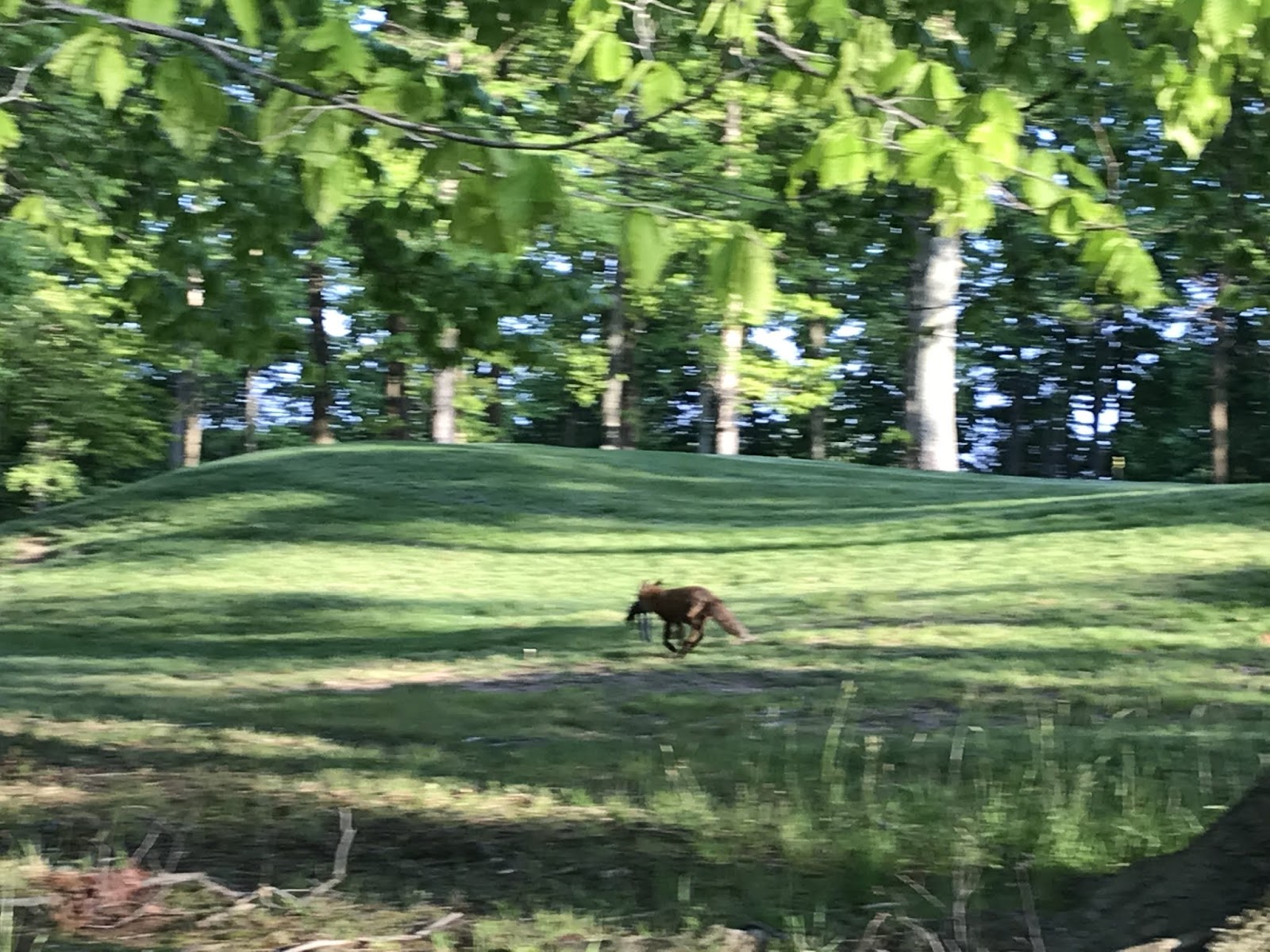
1 and 2. The fox and I have bridged
the vulpine-person divide and become friends. However, she is feeding her cubs
these days and has little time to shoot the baloney. Here, she is pictured
galloping toward the den with unlucky prey (a squirrel?) in her mouth.
3. Beard / Beered. That would be, of course, a stout.
4. I made a mask! (Out of an old
t-shirt.)
5. My parents, Ruth and Marty, getting married, 60
years ago. I am “embedded” with them, in order to help them survive the
pandemic.
6. My parents today, sharing a nice
moment at the kitchen table, having been married for 60 years. Many more happy
returns to them!
The days ahead: Soon, there will be
a video release by Joy on Fire, the band I collaborate with, and eventually I hope to “re-launch”
my latest book release, which got swallowed up by the early days of the nationwide
lockdown. Thanks for visiting this blog—I hope that you and your loved ones are
safe and healthy. —Dan