Showing posts with label DC Poetry. Show all posts

Sunday, March 20, 2022

THE FOX WHO LOVES ME: NEW CHAPBOOK AVAILABLE.


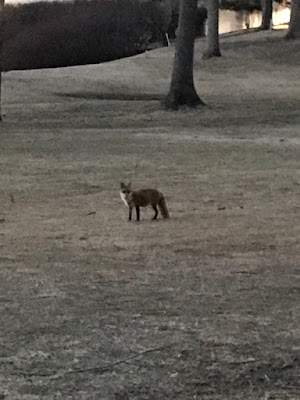
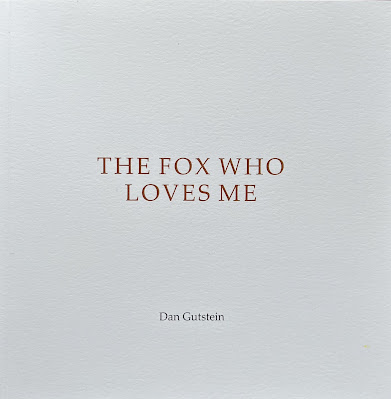
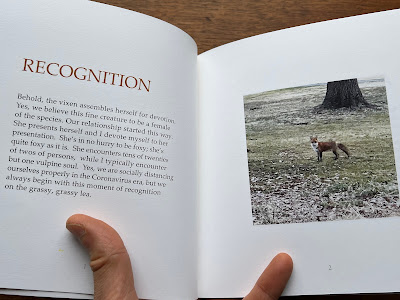
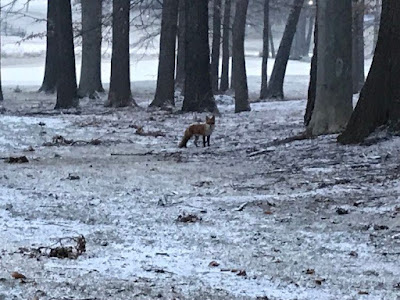
You may recall, Dear Reader, I have befriended a wild red fox, and in the course of this endeavor, I have snapped photographs and composed some snappy prose pieces. Lo and behold, The Fox Who Loves Me has appeared as a perfect-bound chapbook. It features said photography and said prose. Masterfully published by Primary Writing Books, an imprint directed by the estimable Phyllis Rosenzweig of Washington, D.C., The Fox Who Loves Me chronicles my many encounters with this vulpine soul, in summer and winter, light and dark, dry and snow.


The fox herself, a rusty-red vibrant young critter, continues to orbit me. (Or vice versa: I continue to orbit her.) I see her virtually every day, typically around sunset. In addition to her striking colors, she also radiates mischief and intelligence. An opportunistic omnivore, she chows down on rodents and watermelon wedges alike. When I trot, she trots, we trot; we have jogged together several times. Lo and behold, as springtime has blossomed-forth, she has started to keep company with a bloke-fox. I attempt to conquer my heartbreak sensibly: with sessionable stouts and ales.


Let us sing the praises of Phyllis Rosenzweig. Her press has published authors from two generations of the “D.C. Poetry” crowd. Collectively, these Primary Writing Books—penned by the likes of Doug Lang, Ken Jacobs, Lynne Dreyer, Cathy Eisenhower, Chris Mason, Lorraine Graham, and Phyllis herself—explore the boundaries of poetry, prose, and image. Both a writer and curator, Phyllis has garnered MVP honors more than once: I’m recalling, in particular, the pre-pandemic chaos of an Adams Morgan Day street festival, when she joined me and Rod Smith for outdoor-indoor poetry readings at Libertine and the Black Squirrel. The three of us made a formidable team.


The Fox Who Loves Me checks in at 32 pages, with color photographs. Design by Bob Allen. Author illustration by Emily Cohen. To order a copy of this limited-edition chapbook, reach out to Phyllis [email: phyllisrosenzweig at comcast dot net] and she will give you ordering instructions. This would be a perfect gift for fox lovers and poetry lovers alike.  

Please consider supporting the vital work done by small presses. Without them, we would never witness the evolution of language and story. 


Thursday, September 5, 2019

WHERE I AM + WHERE I’M GOING: REFLECTIONS ON MUSIC-MAKING + FILM-MAKING + SEEKING A NEW LITERARY COMMUNITY.

In 2020, Joy on Fire will release a first-ever 
full-length work featuring vocals throughout.


When people ask me what I’m doing with myself these days, the short answer is: making a record, States of America, with Anna Meadors, John Paul Carillo, and Chris Olsen of Joy on Fire, and making a documentary film about the tune “Li’l Liza Jane” with Emily Cohen. (The two activities will eventually intersect when Joy on Fire unfurl a punk-jazz version of “Liza Jane” whilst the cameras roll.) Both music-making and movie-making require a tremendous amount of exertion, as it turns out. One could speculate on the “ups and downs” of the creative cycle, but in reality, there are only up-sides, so long as I’m expending the level of effort that my team-mates require of me. The term “team-mate” of course wouldn’t have applied a few years ago, when I toiled singly as a writer of poems and stories. That work continues, by the way, but unfortunately I’ve grown apart from my long-term involvement with the DC Poetry gang, even as friendships continue with many of its members. Perhaps my next great endeavor will involve entry into another literary community, or founding a brand-new one.

Joy on Fire just concluded an intense period of recordings, as well as a mini-tour that whirled us from the hot rooms of a classic music space in West Philly to a Jersey Shore pool party (“lol”) to the fabulous Lou Costello Room in Baltimore’s Hampden neighborhood. The mini-tour, three venues in three nights, required a fair amount of howling, and by the end, I was a bit hoarse. Joy on Fire describe themselves as “punk jazz,” which means that they’re not timid. To be heard requires projection. It’s quite a different environment from the “funereal quiet” of many literary readings. Even when I’ve given readings in bars, or at outdoor beer festivals, or at flash mob events, I’ve been able to declaim without howling, but now I howl, and truth be told, where has howling been all my life? (I seem to recall a poetry book whose title involved a form of that word—either in advocacy of said act or as testament to its arrival as an art form.) To howl isn’t even half of it, of course. Music and words had to be joined together, in a series of trials, with each member of the combo placing her or his stamp on them. But the biggest adjustment, for me anyhow, has been doing everything by memory. How many times as a writer (hundreds?) have I stood at a lectern, holding the words to my eyes, for easy recital? Don’t do and you won’t learn; don’t learn and you won’t grow. Become a vocalist in a punk-jazz orchestra! 


The great Cajun musician, Iry LeJeune, who died 
in 1955 at age 26 after being struck by an automobile.


Over the course of two years engaging in pre-production tasks centering on Li’l Liza Jane: A Movie About A Song, Emily and I have built a powerful, unbelievable cultural history for a tune—dare I say—more unique than any tune that has developed in North America. I should say “family of songs” since the many titles, melodies, and lyrics easily approximate the breadth of a poetic forms handbook. The research discoveries have been shocking, even triumphant, particularly since they’ve been extraordinarily difficult to achieve, in certain instances. We’ve been mentored by some of the greatest folklorists in the country, including Grammy-winner and author of Big Road Blues, David Evans, who has guided us in the present and “in the past,” and when I say “in the past,” I refer to both historical information as well as an article he published years ago that helped us establish a relationship between the “Liza Jane” family and the Cajun standard “J’étais au bal” (“I was at the dance.”) If you play the version, say, by Cajun legend Iry LeJeune, you can hear where the melody of “J’étais au bal” (sometimes known as “J’ai été au bal”) overlaps with the “Liza Jane” family. This relationship is but one pinprick of starlight—out of hundreds—that helps to establish “Li’l Liza Jane” as a monumental constellation. We look forward to fully telling the epic story of America’s favorite Poor Gal. 
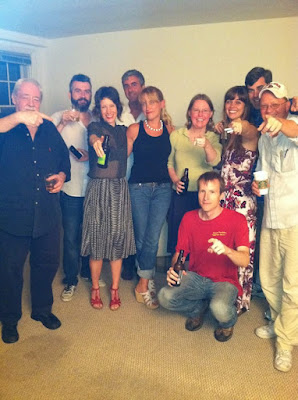

An apartment poetry reading for out-of-town 
literary visitors Cathy Wagner and Susana Gardner.


It’s no accident that I chose a song as subject matter for a documentary foray, since folk poetry informs part of its lengthy history. The thought of poetry sometimes turns my mind toward writing community, and my association with the DC Poetry crowd, in particular. My relationship to that group involved hosting dozens of parties (many legendary); hosting the popular Beer Club Salon of Ideas; and co-hosting several popular happy hours over the course of two decades (Drink & Walk and Public Office Hours, to name two). I even started DJ’ing from my Shakers and Jump Blues projects as the DC Poets took over the basement of the Black Squirrel on Thursday nights for many seasons. I’m grateful for abiding friendships with many writers and performers who hail from both generations of the DC Poetry scene (many now expatriates), including Rod Smith, Heather Fuller, Mark Wallace, Terence Winch, Phyllis Rosenzweig, Tina Darragh, Doug Lang, Casey Smith, Susana Gardner, Joe Ross, Cathy Eisenhower, Maureen Thorson, and Tom Orange, among others. Things change, of course, and I wish the DC Poetry scene good tidings even as I contemplate the next literary community to join (or found).

I’m excited for 2020, when my collaboration with Joy on Fire will result in the release of a limited-edition LP on 180 gram vinyl as well as an EP of six songs. Li’l Liza Jane: A Movie About A Song will enter production, combining an impressive roster of musicians and scholars who will create a durable monument to a deserving folk tune. All the while these two projects have been percolating, I’ve been adding to, shaping, and editing several manuscripts, including a novel, a collection of stories, and at least one collection of poems. I’d love to start reading from my creative writing again, and I’d also love to identify publication opportunities for these manuscripts. Too, I’m nomadic right now, splitting time between the care of my elderly parents and the makes-takes of Trenton, N.J., so I’m on the lookout for an unoccupied shotgun shack somewhere in eastern U.S.A. I’d be interested in knowing if there’s a literary collective out there which needs a bloke like me, or if others felt like bonding together in order to form one. For these, or any reasons, drop me a communiqué, yo! Meanwhile, best wishes to you, and thanks for taking a gander at this here Statement of Human-being-ness. xo
Wednesday, February 19, 2014

THE IDEA OF A PUBLIC OFFICE HOURS.

The famous “Fake Attack” @ Drink & Walk, circa 2006.


In the late 90s and early oughts, my good friend MarkWallace and I co-hosted a “public alighting” that we termed “Office Hours.” We established ourselves at the Post Pub dive bar in D.C., on an appointed night (memory tells me Wednesday), at an appointed time (8:00 p.m.), and people knew where they could join us for conversation and merriment, every week at the very same moments. Mark and I both adjuncted in those days; our students frequented Office Hours to speak about their classwork. The gathering, in addition, featured a writing theme, and many colleagues from the DC Poetry crowd joined us; poetry students from the George Mason MFA Program joined us; the friends of these many good people joined the gathering as well. Some nights, Mark and I might have ministered to a single visitor, when other nights attendance swelled beyond fifteen or twenty people. Mark came up with the idea for the gathering, and if memory serves me properly, he had devised Office Hours in the image of another similar gathering that he had learned of in his travels. The Russian Poet Arkadii Dragomoshchenko (1946-2012) once told Mark to meet him at his office hours, but Mark couldn’t find him on campus. A friend later told Mark that by office hours, the poet meant a bar he frequented.

When Mark left Washington, D.C. for California, my good friend Rod Smith and I sought to replace Office Hours with an updated happy hours for students and writers. We hunted around town for a replacement location, and as the “hunting-around-town” often involved several watering holes on a given evening, we decided that we enjoyed the multi-site aspect of this field research, and in the end, conceived of a two-site happy hours. Dubbed “Drink & Walk”, the gathering commenced at a pub in Adams Morgan, on Thursdays, around 6:00 p.m., and at 7:45, we listed out into the evening and walked to the Red Room Bar at the Black Cat, where Drink & Walk continued until 10:00. People knew they could meet us at Angles, the first pub, or along the walk, or at the Black Cat, or they could participate in all three phases. Students attended, friends attended, visiting writers attended, Everywhere Man attended, and Everywhere Moped sat nearby, chained to a parking meter and tormented by street toughs. Whatever happened to Everywhere Pomeranian, I wonder, locked up in that ATM machine at the falafel place? Some nights, we attracted a fine crowd of six to eight people but some nights were all-out parties of forty or more. Together with third co-host, Mel Nichols, I created a blog of the same name, which lives on in a server someplace on earth. Drink & Walk persevered for about two years until a variety of circumstances (new jobs, etc.) forced changes in routines.


The packed bar at The Black Squirrel for StoutParty.
The DC Poetry crowd inspired and attended the event.


These public gatherings, moreover, served to create (1) buzz (2) community (3) offshoot events such as house (and apartment) parties; (4) enduring friendships (5) extreme storytelling where none existed before (6) energy for the various poetry reading series about town (7) happenstance (8) recipe sharing (9) wine woogie; and (10) there is no 10. I can’t emphasize enough the need for a gathering, as such, to be dependable, week-in, week-out. The weather might’ve been crappy; the co-host might’ve been ill; there might’ve been a keen event someplace else—but Office Hours and Drink & Walk always had to go through! We also brought with us: commerce. Some locales treated us better than others, but in the end, we brought regular business where nobody else brought regular business. The current version of DC Poetry Happy Hours, a legend in its own right, takes place at our partner pub, The Black Squirrel, where a number of us have hosted readings, given readings and participated in special events, such as DuoExchange and StoutParty. We can be found there every Thursday night, starting around 8:00 p.m., but owing to The Idea of a Public Office Hours, as well as A Need for a Public Office Hours, I have a special announcement to make:

I shall be holding my Spring 2014 Public Office Hours—for the remainder of the winter and through the middle of May—at The Black Squirrel, upstairs, at the bar, from 8:00 p.m. until 10:00 p.m. You will find me there every week, on Monday evenings, at those times. Come along if you’d like to discuss coursework or craft stout or poetry or fiction or Swansea City Football Club or jazz or jump or anything else. I shall be very grateful for your company.