Showing posts with label Poetry. Show all posts

Sunday, March 20, 2022

THE FOX WHO LOVES ME: NEW CHAPBOOK AVAILABLE.


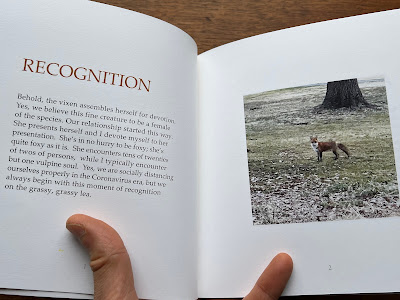
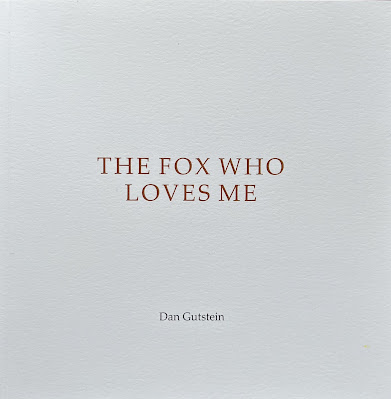
You may recall, Dear Reader, I have befriended a wild red fox, and in the course of this endeavor, I have snapped photographs and composed some snappy prose pieces. Lo and behold, The Fox Who Loves Me has appeared as a perfect-bound chapbook. It features said photography and said prose. Masterfully published by Primary Writing Books, an imprint directed by the estimable Phyllis Rosenzweig of Washington, D.C., The Fox Who Loves Me chronicles my many encounters with this vulpine soul, in summer and winter, light and dark, dry and snow.


The fox herself, a rusty-red vibrant young critter, continues to orbit me. (Or vice versa: I continue to orbit her.) I see her virtually every day, typically around sunset. In addition to her striking colors, she also radiates mischief and intelligence. An opportunistic omnivore, she chows down on rodents and watermelon wedges alike. When I trot, she trots, we trot; we have jogged together several times. Lo and behold, as springtime has blossomed-forth, she has started to keep company with a bloke-fox. I attempt to conquer my heartbreak sensibly: with sessionable stouts and ales.


Let us sing the praises of Phyllis Rosenzweig. Her press has published authors from two generations of the “D.C. Poetry” crowd. Collectively, these Primary Writing Books—penned by the likes of Doug Lang, Ken Jacobs, Lynne Dreyer, Cathy Eisenhower, Chris Mason, Lorraine Graham, and Phyllis herself—explore the boundaries of poetry, prose, and image. Both a writer and curator, Phyllis has garnered MVP honors more than once: I’m recalling, in particular, the pre-pandemic chaos of an Adams Morgan Day street festival, when she joined me and Rod Smith for outdoor-indoor poetry readings at Libertine and the Black Squirrel. The three of us made a formidable team.


The Fox Who Loves Me checks in at 32 pages, with color photographs. Design by Bob Allen. Author illustration by Emily Cohen. To order a copy of this limited-edition chapbook, reach out to Phyllis [email: phyllisrosenzweig at comcast dot net] and she will give you ordering instructions. This would be a perfect gift for fox lovers and poetry lovers alike.  

Please consider supporting the vital work done by small presses. Without them, we would never witness the evolution of language and story. 


Thursday, March 3, 2022

NEW BOOK OF POETRY METACARPALISM NOW AVAILABLE.


Poetry. Published by Unsolicited Press (February 2022). 98 pages. Design by Kathryn Gerhardt. Edited by Alexandra Lindenmuth. Available online at Unsolicited Press website, Amazon, Barnes & Noble, and Books-A-Million. Available in Washington, D.C. at Bridge Street Books and Politics & Prose (Connecticut Avenue).

In a nutshell:

Per the memo recently circulated in triplicate, Metacarpalism establishes new standards for humor, elegy, and form(lessness). [n.b. Future works that don’t measure up will be returned to the factory.] These very lovely strophes memorialize after-sex ambiguities, Beef Pineapple Robots, (C)harm Cities, Peoples Who Don’t Listen to Music, anybodies (sic) named Danish Kroner, and sonnets, although what is a sonnet, everything is, nothing is, whazzzzapppp! You will laugh. You will weep. Simultaneously. Or separately. Kind of like a front flip and a backflip all at once. Or separately. Purchasing a copy will support a great small press. Thank you for your time and consideration. Well all right then. Two sample poems:


I’ve Got That on My Radar

—I’ve got that on my radar.
—Me, too.
—Do other people have it on their radars?
—Everyone has this on his or her radar.

 
—Remember the days of no radar?
—What was there if there was no radar?
—Carburetors?
—Faithfulness?

 
—Heh heh heh.
—Heh heh heh.
—When my girlfriend moved in, she kept her radar.
—More women are keeping their radars these days.


—Do you see blips?
—Only when I stand up too quickly.
—Sometimes when I’m alone, I hear applause.
—Maybe you’ve got The Clap.

 
—Okay, I’ve got that on my radar.
—Do you have it on your sonar?
—Should I have it on my sonar?
—The sea ice, after all, is melting. . .


—Do you have that on your deep space probe?
—I’m not sure I care for that phrase.
—(…)
—(…)

 
—Does man drum in the woods?
—Do you drum in the woods?
—I have no drum. There are no woods.
—Then you must throw percussion to the wind!

The Emporium of Youth

Seen from another angle as when an area—
station, square—contemplated on a Sunday.
The expression may calcify into a demonstration
of thistle-thorn dismay. By “imagine your face”
I mean “shadow,” your expression itself a shadow.
These colors: sky, stone, graffiti: these colors now.
The emporium of youth versus the emporium
of adulthood. If Person A will ail at Point X,
then Person B will ail at Point Y. (Loneliness
aggrandizes the symmetrical nature of most pain.)
Whereas a big galosh of dirty cloud busts open
a caucus of old doves. Brighten the ticking synapses
versus what warms the solid-state capacity for violence.
These colors: stone, wood, tower: these colors now.
The difference between idling (unit of riverbank)
and waiting (unit of high-rise). Rust, rusty coloring,
what gnaws into our porticos of awareness.
By “imagine your face,” I mean the uncorrected
ritual of love. Or the sliding scale of sunlight,
or the balloting of voices in airshafts and alleys.

Thursday, September 5, 2019

WHERE I AM + WHERE I’M GOING: REFLECTIONS ON MUSIC-MAKING + FILM-MAKING + SEEKING A NEW LITERARY COMMUNITY.

In 2020, Joy on Fire will release a first-ever 
full-length work featuring vocals throughout.


When people ask me what I’m doing with myself these days, the short answer is: making a record, States of America, with Anna Meadors, John Paul Carillo, and Chris Olsen of Joy on Fire, and making a documentary film about the tune “Li’l Liza Jane” with Emily Cohen. (The two activities will eventually intersect when Joy on Fire unfurl a punk-jazz version of “Liza Jane” whilst the cameras roll.) Both music-making and movie-making require a tremendous amount of exertion, as it turns out. One could speculate on the “ups and downs” of the creative cycle, but in reality, there are only up-sides, so long as I’m expending the level of effort that my team-mates require of me. The term “team-mate” of course wouldn’t have applied a few years ago, when I toiled singly as a writer of poems and stories. That work continues, by the way, but unfortunately I’ve grown apart from my long-term involvement with the DC Poetry gang, even as friendships continue with many of its members. Perhaps my next great endeavor will involve entry into another literary community, or founding a brand-new one.

Joy on Fire just concluded an intense period of recordings, as well as a mini-tour that whirled us from the hot rooms of a classic music space in West Philly to a Jersey Shore pool party (“lol”) to the fabulous Lou Costello Room in Baltimore’s Hampden neighborhood. The mini-tour, three venues in three nights, required a fair amount of howling, and by the end, I was a bit hoarse. Joy on Fire describe themselves as “punk jazz,” which means that they’re not timid. To be heard requires projection. It’s quite a different environment from the “funereal quiet” of many literary readings. Even when I’ve given readings in bars, or at outdoor beer festivals, or at flash mob events, I’ve been able to declaim without howling, but now I howl, and truth be told, where has howling been all my life? (I seem to recall a poetry book whose title involved a form of that word—either in advocacy of said act or as testament to its arrival as an art form.) To howl isn’t even half of it, of course. Music and words had to be joined together, in a series of trials, with each member of the combo placing her or his stamp on them. But the biggest adjustment, for me anyhow, has been doing everything by memory. How many times as a writer (hundreds?) have I stood at a lectern, holding the words to my eyes, for easy recital? Don’t do and you won’t learn; don’t learn and you won’t grow. Become a vocalist in a punk-jazz orchestra! 


The great Cajun musician, Iry LeJeune, who died 
in 1955 at age 26 after being struck by an automobile.


Over the course of two years engaging in pre-production tasks centering on Li’l Liza Jane: A Movie About A Song, Emily and I have built a powerful, unbelievable cultural history for a tune—dare I say—more unique than any tune that has developed in North America. I should say “family of songs” since the many titles, melodies, and lyrics easily approximate the breadth of a poetic forms handbook. The research discoveries have been shocking, even triumphant, particularly since they’ve been extraordinarily difficult to achieve, in certain instances. We’ve been mentored by some of the greatest folklorists in the country, including Grammy-winner and author of Big Road Blues, David Evans, who has guided us in the present and “in the past,” and when I say “in the past,” I refer to both historical information as well as an article he published years ago that helped us establish a relationship between the “Liza Jane” family and the Cajun standard “J’étais au bal” (“I was at the dance.”) If you play the version, say, by Cajun legend Iry LeJeune, you can hear where the melody of “J’étais au bal” (sometimes known as “J’ai été au bal”) overlaps with the “Liza Jane” family. This relationship is but one pinprick of starlight—out of hundreds—that helps to establish “Li’l Liza Jane” as a monumental constellation. We look forward to fully telling the epic story of America’s favorite Poor Gal. 


An apartment poetry reading for out-of-town 
literary visitors Cathy Wagner and Susana Gardner.


It’s no accident that I chose a song as subject matter for a documentary foray, since folk poetry informs part of its lengthy history. The thought of poetry sometimes turns my mind toward writing community, and my association with the DC Poetry crowd, in particular. My relationship to that group involved hosting dozens of parties (many legendary); hosting the popular Beer Club Salon of Ideas; and co-hosting several popular happy hours over the course of two decades (Drink & Walk and Public Office Hours, to name two). I even started DJ’ing from my Shakers and Jump Blues projects as the DC Poets took over the basement of the Black Squirrel on Thursday nights for many seasons. I’m grateful for abiding friendships with many writers and performers who hail from both generations of the DC Poetry scene (many now expatriates), including Rod Smith, Heather Fuller, Mark Wallace, Terence Winch, Phyllis Rosenzweig, Tina Darragh, Doug Lang, Casey Smith, Susana Gardner, Joe Ross, Cathy Eisenhower, Maureen Thorson, and Tom Orange, among others. Things change, of course, and I wish the DC Poetry scene good tidings even as I contemplate the next literary community to join (or found).

I’m excited for 2020, when my collaboration with Joy on Fire will result in the release of a limited-edition LP on 180 gram vinyl as well as an EP of six songs. Li’l Liza Jane: A Movie About A Song will enter production, combining an impressive roster of musicians and scholars who will create a durable monument to a deserving folk tune. All the while these two projects have been percolating, I’ve been adding to, shaping, and editing several manuscripts, including a novel, a collection of stories, and at least one collection of poems. I’d love to start reading from my creative writing again, and I’d also love to identify publication opportunities for these manuscripts. Too, I’m nomadic right now, splitting time between the care of my elderly parents and the makes-takes of Trenton, N.J., so I’m on the lookout for an unoccupied shotgun shack somewhere in eastern U.S.A. I’d be interested in knowing if there’s a literary collective out there which needs a bloke like me, or if others felt like bonding together in order to form one. For these, or any reasons, drop me a communiqué, yo! Meanwhile, best wishes to you, and thanks for taking a gander at this here Statement of Human-being-ness. xo


Wednesday, February 27, 2019

DREADFUL POEMS CONTINUE TO APPEAR IN BIG MAGAZINES: COMPLAINT.


A few years ago, we took a critical look at James Richardson’s poem, “Essay on Wood,” that had appeared in the The New Yorker. We didn’t “measure” our comments then, and we won’t measure our comments today, either, when we take a look at Elizabeth Spires’ poem, “How to Sing,” which recently appeared in The Atlantic. Our analysis of Richardson’s poem wasn’t personal, and neither will be our commentary at present. Elizabeth Spires is a major American poet, in any event. According to Wikipedia, she has received a Guggenheim Fellowship as well as grants from the National Endowment for the Arts and the Whiting Foundation. She has published several volumes with W.W. Norton, in addition to one collection apiece with Wesleyan and Carnegie Mellon. As with Richardson, I’ve met Spires, and heard her read, albeit many years ago in Washington, D.C. No, we don’t seek to impeach these accomplishments or the person herself, but we do want to scrutinize the poem’s language, structure, and theme(s).

The poem is short enough to reproduce in its entirety:

               How to Sing

               from a hymnal

               Moderately
               Moderately slow
               Moderately fast
               With vigor
               In flowing style
               Boldly
               Well marked
               Fervently
               With dignity
               With great dignity
               Joyously
               Joyously, but not too fast
               Resolutely
               With stately vigor
               Rather slowly
               Not too slowly
               Majestically
               With joyous dignity
               With movement
               With flow

               —Elizabeth Spires, from The Atlantic (January/February 2019)

In its favor, “How to Sing” doesn’t take very long to read. Let’s not make the mistake of regarding the poem, thematically, from a monochromatic standpoint. Ostensibly, it refers to singing, but forgetting the italicized epigraph (“from a hymnal”) for a moment, let’s assume that Spires would like readers to interpret “How to Sing” on multiple levels. The possibilities include betraying, chirping, and crooning, but first let’s investigate this piece as it may apply (of course!) to fornication. We mean love-making. If we may say so, clearly the love-maker is being asked to sing “With vigor” “…but not too fast.” “Majestically” and (of course!) “With flow.” This is how many love-makers are asked to make love, so there’s nothing really new on that frontier, but okay, okay, let’s say this poem is really about crooning, even religious crooning, and if so, how is the singer being advised to practice her or his craft? [n.b. “Moderately slow” and “Moderately fast” are redundant.] “With dignity” and “Joyously, but not too fast” calls to mind the right-wing Bobcat Muzak played at Chick-fil-A and Walmart. I’m hearing The Partridge Family. I’m hearing Spandex Ballet, oops, I mean Spandau Ballet. “With stately vigor” rules out any character in the voice, yet perhaps Spires advocates for religious fervor to be “medium” these days. Pray medium. Sing medium.

What to make, though, of “from a hymnal?” When the word “from” prefaces a poem, it often suggests that the published piece is an excerpt from a longer work, but we don’t perceive that Spires has crafted a longer work entitled “A Hymnal,” and besides, “from” is italicized along with “a hymnal,” which is lower case and appears without quotation marks. Did she excerpt this from a book of religious songs out there in the real, crooning world? This is a possibility, but then why would she seek to publish that in The Atlantic, or why would she claim authorship at all? Does “from a hymnal” refer to an alternative definition of hymnal (see our fornication theory, above) or is the reader simply meant to transfer the weight of “hymn,” from an oddly fictional hymnal, onto the lifeless prayer-jargon that follows? Just what is the larger piece that these italics refer to—we don’t know. Perhaps we haven’t reached the level of enlightenment we must reach, in order to decipher this clue. Its inclusion calls attention to the poem’s structure, however, which is a block of short lines, easy enough, but we wonder (“We WAH WAH WAH WAH / Wonderrrrrrr / WHYYYYYY) if the poem couldn’t be broken and clipped, severely. Maybe this would be a better piece:

                  How to Hymn
  
                  With vigor
                  in flowing
 
                  dignity. Joyously,

                  but not too
                  stately.

                  Rather
                  not too
                  with
                  with
                  flow.

Surely now it is a l=a=n=g=u=a=g=e poem (eek! salt the brisket! run for the hills!) but it is less predictable across its language, form, and theme(s). It demonstrates alternative techniques. There are rests. There are restarts. Each participant is holding a backward palm to her or his forehead!

We turn to our panel of experts, The Machine, Sausages, and Fluffy, which is advising this blog during Complaint Week 2019:
            Fluffy suggests that “Maybe The Atlantic hired The New Yorker poetry editor.”
            Sausages says, “Everything is a characterless glass building with a Whole Foods, Starbucks, and Politics and Prose in the lobby.”
            The Machine adds, “How many words does it have? How are you going to monetize that shit?”

Thank you, gentlemen. If we follow Wallace Stevens’ example, “The Atlantic and The New Yorker are one.” If poetry fits into “everything” and we think it does, then poetry has a Starbucks in the lobby. And as for “(monetizing) that shit,” I wonder how much The Atlantic pays for a poem. I would imagine quite a bit, since The Atlantic, by virtue of its name, purports to be an entire ocean.


Layli Long Soldier


I recently read Whereas, a fine collection of poetry by Layli Long Soldier, which was published by Graywolf in 2017. Some of the poems have been tremendous. In part of her sequence, “Vaporative,” she interprets the word “opaque” as “OPĀK” or more fully “O: open / P: soft / Ā: airplane or directional flight / K: cut through—translating to that which is or allows air, airy, penetrating light, transparency.” Of course a good poet can turn the impenetrable to penetrable.  The Atlantic (which does praise Long Soldier in an article or two) could stand to publish a poem of hers, so she could explain to an audience as vast as the ocean that “a word of lightful meaning flips under / buries me in the work of blankets.” (Beautiful!) (Complaint.)


blood and gutstein complaint week 2019: no solutions—just gripes
monday: democrats
tuesday: education
wednesday: poetry
thursday: beer
friday: sports


Wednesday, January 21, 2015

RIMBAUD: FIRST BLOOD.

Yo, Verlaine! That poem sucks!


Sylvester Stallone stars as Rambo in Rimbaud: Première Sang, an action-adventure film in which a young French poet escapes persecution by literary critics and avenges this persecution with surreal verse. “Yo, Verlaine!” says Stallone as Rambo as Rimbaud. “They drew first blood, not me!” Verlaine, played by Bruce Willis, sits in a hovel with Rambo as Rimbaud, having helped Rimbaud elude water cannon and the poetry cannon. On the one hand, Willis plays Verlaine, but on the other hand, Stallone plays Rambo playing Rimbaud. The production crew can’t automatically compute where Stallone ends and where Rambo begins, where Rambo ends and Rimbaud begins. One scene, a bro-mance entitled “Ram-bro”, calls for a passionate fist-bump between Rambo as Rimbaud and Willis as Verlaine. Afterwards, Stallone and Willis compare their future engagements. Willis will appear as a Jewish wine merchant, in a TV series entitled Chico and the Manischewitz. Stallone will appear on a rival network—as a fellow who suffers from gynecomastia—in Chico and the Man Boobs. “Yo, Verlaine!” cries Stallone as Rambo as Rimbaud, but the camera shows the viewer that Willis has departed. Rambo as Rimbaud holds a battered sheet of onionskin to his face. The camera shows a dirty, sweaty, camouflaged man reading verse. He is Rambo one minute, he is Rimbaud another minute, he is a real laughing hiatus. 


Tuesday, April 22, 2014

THE SECOND GREATEST POETRY WRITING EXERCISE IN THE WORLD: FOR TEACHERS & POETS.


Assign three poems for your students to read before the next session. These poems ought to have some common threads, in terms of the writing style or content, but that’s not required. In the meantime, cut 15 words out of each poem. (This exercise assumes a class size of 15 students.) (Adjust as needed.) Choose words carefully: pick nouns that might double as verbs; avoid too many modifiers; include a few muscular verbs but you’ll probably want to err on the side of choosing more nouns than anything else; don’t worry about prepositions, articles, or conjunctions; select a rich vocabulary. When done, place the cut-out words from each poem into a separate envelope. That is, the 15 words from Poem A should go into their own envelope, the 15 words from Poem B should go into their own envelope, and the same for the words from Poem C. Arrive at class with three sealed envelopes in hand, A, B, and C. You could always type-up the words in a festive font, if you’re the benevolent sort.

Lead a discussion of the three poems. For this exercise, I had chosen “Colorado Blvd.” by Lorna Dee Cervantes, “Santa Fe” by Joy Harjo, and “The Colonel” by Carolyn Forche. I dig these three pieces. Two of the three were written in prose, and the Cervantes poem, which employs line breaks, offers the tidy block of its one stanza. The narrators describe similar worlds, in which they, as women, face danger or cope with marginalization; contemplate escapes or seek justice; dream with all the resources of their imaginations or bend the rules of time or narrate startling transformations. Leave about 40 minutes for the writing exercise.

Now you get to haul out the three envelopes. Send them around the class. Every student should select one word from each envelope. Once the envelopes have circulated around the room, every student should possess one word from each poem, and three words total. Ready a stop watch. Students should incorporate the three words into a couple lines of poetry, or a sentence, before two minutes have elapsed. Run a tight ship. Once the two minutes have expired, students should pass their three words to the person sitting beside them. The three words, therefore, will “rotate over” to the student’s neighbor. Once they have received their three new words, students should write another couple lines of poetry or another sentence—you got it—in two minutes or less. Keep practicing this ritual until the word groupings make a full rotation around the room, until the poets receive their original three words. At that point, the exercise should stop. Your students might have guessed at where the words came from, but at this point, you can tell them.

The exercise forces students to work swiftly, and to emulate a compelling vocabulary. Every two minutes, of course, a fresh set of words arrives and requires the student-poets to be inventive, to fit the new words into the emerging poem. The language, itself, tends to establish the poem’s situation, and by its very nature, the exercise creates surprise: the three new words must be puzzled into the whole. Students, in my estimation, should train themselves to write from certain rich vocabularies, and should cultivate the habit of altering rhythms and word choices from line to line. “Evolution ain’t just a theory that governs the animal kingdom.” The exercise created buzz. The poems jumped. We read them raw and loud. I call this the second best poetry writing exercise in the world, since I happen to have devised the best poetry writing exercise in the world, as well. If you’d like to know about that one, well then: buy me a stout.

Tuesday, December 3, 2013

SOME WORDS FROM THE MURDER VAULT.

Warren Fulton on the Key Bridge in Georgetown (1988)


Twenty-five years ago, on Saturday, December 3rd, 1988, I left my good friend, Warren Fulton, and his girlfriend, Rachael, at a pub in Washington, and went home for the night. Months earlier, I’d given Warren a key to the apartment that I shared with two other students; he crashed on our couch so often, he became a roommate. He might’ve meant to stay with his parents at his official residence in Vienna, Va., or he might’ve wound up at Rachael’s place, but he and Rachael were never seen again, alive. For two days, they were missing. Warren hadn’t materialized Sunday night in particular, which was odd, since he had weights with the baseball team early Monday mornings, and his crash pad, i.e., my pad, was mere blocks from the gym. By Tuesday, the radio news announced the discovery of two bodies in a field near a highway in Virginia. One of my roommates and I decided to drive around, into Virginia, back to D.C., and so forth, all the while listening for developments. I never wanted to get word of Warren’s death, but not knowing his plight was excruciating, too. (I would better comprehend the complexities of “wanting a resolution” a couple years later, when my brother lay comatose in the ICU, his body ruined by metastatic disease, a machine breathing for him.) By Tuesday evening, a group of friends had gathered at the apartment. A TV news anchor revealed that Warren and Rachael were the “two bodies”; they’d been murdered. We hugged each other. We screamed “No!” together. I slugged a wall pretty good. How should one react?

Police could not solve the murder straight away. The killer, who had abducted the two in Rachael’s car, drove the same car to New York, where it sat for a while before being ticketed, of all things. Detectives had not developed a motive, had not identified a suspect, and had not discovered a weapon, although they had recovered DNA evidence from the crime scene. In time, the DNA evidence would link the same killer to another open murder investigation in Northern Virginia; my friend, apparently, had been slain by a serial killer. Much time would pass between breaks in the case. Seventeen years after Warren and Rachael had been killed, police at last matched the DNA to a California inmate who’d been sentenced to that state’s Death Row for torturing and killing a 15 year old girl. He was extradited to Virginia, where, in 2007, he stood trial for the double-killing, a process that would become nearly as epic as the hunt to identify him in the first place. The initial trial, which I attended, resulted in a mistrial, after one juror ‘impeached’ his own verdict. (He changed his mind, that is, after he had willingly participated in declaring a unanimous guilty verdict.) A second trial would end in a capital murder conviction, but its sentence, a death sentence, would be washed out on a technicality. A third trial, which retried the penalty phase alone, concluded with the jury recommending a death sentence that the judge upheld. The killer was defended by the same law firm and the same team of lawyers who represented the infamous “D.C. Sniper.”

I won’t comment on the crime, which was barbaric, and I won’t comment on the killer, who is suspected in other slayings beyond the four mentioned here, and I won’t comment on the sentence the killer received, (one he continues to appeal), and I don’t want to speak of the other victim, Rachael, as I didn’t know her very well. I’d like to say a few words about Warren, who’s had an influence on my life. To begin, he cared about poetry and he enjoyed writing. This spurred me to write, and what little I may have accomplished as a writer, in some way, doubles back to the pleasure that Warren took from poetic expression. I’ve published pieces about him in magazines and many of the same pieces can be found in my two books. Mostly, he wielded what I’ll call “A Formidable Wit.” He had a way of attacking you when you were moping. His practical jokes were estimable. I could tell you the midnight Atlantic City story, the woman who lost her bikini top story, the “what’s happening, dude?” story, the Taco Bell grande story, the stealing second base and what the umpire said story, the “well, there’s no other way to put it story, and among others, the goof off day story, during which, Warren needed dough and decided he would acquire these funds by marching into 7-11, spending $2 on a scratch-off lottery ticket, and winning, which he did, he won enough bread to fund an ensuing goof off night for the two of us. “I didn’t need a Plan B,” he said. “I was always going to win that money!” If you never met him, I wish you could have. He was my friend.

Tuesday, March 5, 2013

HOW TO READ POETRY (FOR DUMMIES)

The great poet, Robert Hayden


Look here, see now. I say ‘Dummies’ affectionately. As in all those famous self help books—incl. Roots & Tubers, The Real Josef Stalin, The Party of No, and Offshore Drilling—for Dummies. You’re probably not a Bro, Brah or Bruh if you’re reading this post, you’re probably not populating a Pan-Hellenic Greek Org. such as STD or ABV. No, you’re probably a Good Sport who’s attempting to make headway with difficult reading material, so let’s advance Your Cause and score some Lasting Change. As part of our Joint Exploration, we will link to some very fine poems by Robert Hayden, Li-Young Lee, Harryette Mullen, Lyn Hejinian, Robert Creeley, and P. Inman.

1. First of All, Relax. Can you hear Jeff Spicoli (from Ridgemont High) saying that, after he’s crashed the car? (“Ruh-laaax!”) The fact is, you’re probably trying to navigate poetry as you might navigate fiction, by expecting plot or seeking the familiarity of narrative sentence structure. Perhaps you’re expecting the lyrics to approximate pop music or patter through a regular rhyme scheme. In the end, many contemporary poems operate outside these conventions, and you may need to—train yourself to—read differently.

2. ‘Meaning’ Is Overrated. Let’s start with The Big Picture. Do you understand the Universe? Do you comprehend America? Can you explain why one athlete who prays to God triumphs, while another athlete who prays (just as fervently) to the same Lord, fails? If so, proceed to The End and Receive Cookie. Why demand ‘Sense’ from poetry when you cannot wring ‘Sense’ from a glance out the window? Importantly, there are Other Ways to penetrate a poem, and there are Many Ways in which poetry can Reg-U-Late.

3. Determine Situation. I realize that the Intended Audience may vary from piece to piece, but in general, a diligent reader should be able to establish ‘Basic Footing’ in any poem. Consider Robert Hayden’s masterpiece, “Those Winter Sundays.” Written, arguably, in the sonnet form, it establishes a speaker (presumably male) who voices profound regret at never having thanked his father for all his blue collar devotion, indeed “…Speaking indifferently to him, / who had driven out the cold / and polished my good shoes as well.” The poem’s elegiac address allows for many “lonely offices” at the end: the father’s various toiling places as well as the poet’s austere desk.

4. Assemble a List of Images. You can also ‘enter a poem’ by assembling a constellation of its snapshots. The speaker in Li-Young Lee’s poem, “This Hour and What Is Dead”, calls God an “old furnace”, who “keeps talking / with his mouth of teeth, / a beard stained at feasts, and his breath / of gasoline, airplane, human ash.” Through this imagery, a reader can obviously detect the intense upheaval threatening the speaker’s life. What might one group of images—“blueblack cold”, “cracked hands”, and “banked fires”—suggest about the hardscrabble environs of “Those Winter Sundays”?

5. Don’t Fear Responsible Abstraction. Most Irresponsible Abstraction veers into Cheese. The more a phrase—“the dark depths of my soul”, for example—allows for too many destinations, the more the reader can’t attach any significance to it. On the other hand, take Robert Hayden’s line, “fearing the chronic angers of that house”, where “chronic angers” may refer to the latent tension amongst the house’s inhabitants or the cantankerous noise of a cold house warming. The poet doesn’t include an image there, but the abiding originality of this Responsible Abstraction attaches itself to the speaker’s sense of familial alienation, and nourishes the Elasticity of the (Reader’s) Mind.

6. Discover the Slants. Many poems succeed by offering innovative soundings: where words correspond ‘in Slant’ with words that aren’t, thankfully, their sing-song counterparts. I call your attention to the poet Harryette Mullen, and her abecedarian book, Sleeping with the Dictionary, and to the first sentence of “The Lunar Lutheran”, a poem therein: “In chapels of opals and spice, O Pisces pal, your social pep makes you a friend to all Episcopals.” Just in one sentence alone reside many Slants: chapels/opals; spice/Pisces; opals/social; and O Pisces Pal/Episcopal. Can you see how the rhymes aren’t ‘exact’? Doesn’t that line Bounce? The Hayden poem offers intricate sound-work, as well. Trace the “c”, “ck”, and “a” sounds inside words, alliteratively, and in Slant.

7. Thoughts on Macro-Structure. Lyn Hejinian wrote her masterpiece collection, My Life, originally, in 37 parts of 37 sentences apiece, when she was 37 years old. Eight years later, she added eight more sections, and expanded the previous sections, such that My Life grew to hold 45 sections of 45 sentences apiece. But that’s not all. Consider this excerpt, hosted at the University of Buffalo’s Electronic Poetry Center. Her writing—parts image, detail, non sequitur, fragment, definition, list, idea, witticism, and so forth, and all of it in prose—comes to resemble a jazz solo, in that the elements provide a “searching foundation” which soars to stunning moments of discovery.

8. Thoughts on Micro-Structure. Try reading Robert Creeley’s poem, “Goodbye”, by (a) stressing words at the ends of lines and (b) insisting upon pauses between stanzas. Creeley’s organizational strategy emphasizes the emotional stances of persons, the beginnings of thought and speech, and the isolations inherent in ill-fitting relationships. Of course pain is painful, by the way. When someone says “the pain is / not unpainful”, doesn’t that smack a bit? “Those Winter Sundays” was included in a recent edition of The Penguin Book of the Sonnet, even as its fourteen lines are broken a bit unusually for a sonnet. Try reading it as you read the Creeley, and weigh the effectiveness of its breaks.

9. A Difficult Poem. A writer named P. Inman is one of my favorite poets. I didn’t always feel that way, though! When I first heard him read his poetry, I was like, “wtf?” But I was wrong about that. I reflect upon my first cup of coffee, or my first jazz listen, and how neither quite worked for me, but now, having cultivated a love for them, both are irreplaceable parts of my routine. The same with experimental poetry, the works of P. Inman included. Consider his poem, “lac[e]y”, which may be a comment on lace, lacey-ness, or the jazz musician Steve Lacy, and all his Lac[e]y-ness. (It’s dedicated to another hero, the English poet Tom Raworth.) Rather than analyze its ‘meaning’ (right?), let’s just state some observations: the lines are short and metered by numerous periods; the poem reads jaggedly; some of the word combinations—“a. taupe. wald.”, for example—suggest more in the way of sound-scrabble; some stretches provide astonishing connections: ‘“let’s. call. / this.’ / my. age. / leaning. into. / some. dream.”; the piece is separated into six stanzas; sometimes an asterisk breaks the stanzas; the piece is further divided into two halves by an unconventional margin; the piece is (visually) unbalanced—sometimes the left half is heavier (with words) than the right and vice versa; the poem is tightly bound to that unusual margin. P. Inman’s poetry at times reminds me how language and sound is about us, a bit on the street, a bit from the radio, a bit on the subway, a bit from memory, a bit from nostalgia, a bit from wit, a bit from optimism. A piece like “lac[e]y” can be enjoyed for its shape, runs of words, ideas, sounds, scraps, persistent introversion, persistent invention, undeniable authenticity, and for sure, its “polk. m’edge.”

10. The End: Receive Cookie. Hey, if you’re a Bro, Brah, or Bruh, and you’ve made it this far, then there’s hope for you yet. This post will hardly address all the nuances of reading poetry, but if you’ve Gleaned a Few Nuggets, as they say, then it’s time to hit The Pub. Incidentally, Hitting the Pub can help you with No. 1, above. (“Ruh-laaax!”) Good luck and please comment if you’d like to correspond about any of this mayhem.

Also see: Blogpost to a Young Poet.
Thursday, March 24, 2011

THE GREATEST POET, PAUL CELAN


Before Paul Antschel adopted the name Paul Celan, he lost his parents to Nazi deportations and was, himself, a captive laborer in the Old Kingdom (of Romania) until 1944, when the Red Army, self-sprung from Wehrmacht encirclements, pressed into the region. He spoke Romanian and German as a child, acquired Russian during two Soviet occupations, and later mastered French, after settling in France, and marrying an artist. His earliest poems, to my knowledge, were published in Romanian, but the bulk of his works, including his most famous poems, appeared in German: the piece “Todesfuge”, or “Death Fugue”, for example, published in 1948, may be most-cited, and is a stark reminder that Jews, under the Nazi regime, suffered a series of well-orchestrated reductions until the tattered remnants, in the poem, are whistled out as a pack of dogs, by a camp commander who forces them to dig a grave “in den Lüften”, in the wind. Later poems grew clipped and cryptic, perhaps as the poet attempted to corrupt or reinvent the German tongue; he also succumbed to mania and despair. A few years before his death, Celan wrote “Todtnauberg”, a piece that commemorated his meeting with the philosopher (and former Nazi) Martin Heidegger, on the German’s rural property. In this poem, he hoped “for a thinker’s / word / to come, / in the heart,” (of his host, Heidegger) but the twin evils of Nazi genocide and postwar indifference must have been costly to Celan’s wellbeing. Heidegger was said to remark upon the man’s erratic behavior a couple years later, “Celan ist Krank—heillos,” sick with an incurable disease. The poet threw himself into the Seine in 1970, drowning, leaving behind his wife and child. Maybe this deterioration, resulting in suicide, can be traced through Celan’s verse. Small, introspective weights such as “De voi depinde” (it’s up to you), from the Romanian poems, build into greater acknowledgments of darkness and burden. An excerpt, “Die Welt ist fort, ich muß dich tragen” (the world is lost, I must carry you), from a 1967 collection, Atemwende, may additionally refer to the biblical dilemma faced by Abraham, when called upon to sacrifice his son, Isaac, even as the reader may conjure the poet’s mother, instead, lost to a bullet from an Einsatzgruppen rifle. Later, Celan would write, “Vertag dich nicht, du,” or “Don’t adjourn yourself, you.” Paul Celan’s titles, in the collections that followed Atemwende, include Fadensonen, for Thread-suns; Lichtzwang, for Light-strength; and Schneepart, for Snow-part. The titles, in translation, approximate spectra, sensory fusion, meters that compute natural units. The word, Atemwende, itself, which translates to “Breath-turn”, nourishes many Celan aficionados, who cherish the sense of exhilaration that accompanies the genesis of poetry. Call it exhilaration or corporeal necessity, but the “bloodblack” edges throughout Schneepart, for instance, are tempered by a “magnolia-houred halfclock” that keeps unorthodox time as the speaker promises, “I’m wintering over to you.” Perhaps my reverence for Celan’s writings (poetry, prose, translations, letters) springs, in some small way, from my own (inept) Jewish militancy, misplaced angers over the loss of mother’s-side family members to the Shoah, Holocaust, or what Celan termed, “that which happened.” Celan concluded a poem, written to his wife in French, on the occasion of her birthday, by reflecting upon his hand, how it drew “l’un, l’unique / cercle”, the one, the only circle. They were, apparently, living apart, but very much in love, and yet, a short while later, Celan would take his own life, rounding-out an anguished, solitary circumference. Reading and re-reading is a circle of its own, and in so doing, fulfills a poignant request: “Trink aus meinem Mund”, the poet wrote, drink from my mouth——this wisdom——and I do.

Thursday, February 17, 2011

TWENTY WORKS OF AMERICAN POETRY (+ 5) THAT YOU MUST READ BEFORE YOU CAN HAVE A CONVERSATION WITH ME ABOUT POETRY (written between 1820 - 1980).

One of the cornerstones.


A friend and I constructed a first draft of this list as a means of passing time, when returning from the MLA Conference in Los Angeles, more than a month ago. We originally called it "The Twenty Most Important Works of American Poetry (+5)" and I posted it as a 'note' on Facebook, in order to elicit some (heated) criticism. It was also (hotly) debated at DC Poetry Happy Hours (at The Reef) and via several (volcanic) email exchanges with people who reside without the District. Good points were made about (1) some of the works (i.e., we had foolishly listed the wrong collection for T.S. Eliot) and about (2) the title -- that, in the end, we could not necessarily be arbiters of "most important", since "importance" means different things to different people, but instead could put forward the list as a set of "relevant guideposts" for anyone who might wish to comment on the broad sweep of American poetry. Perhaps we were thinking as teachers; perhaps, we reasoned, these works should be read by students of ours who aspire to study American poetry or enter the "po' bidness" themselves. The list is not perfect, and I welcome a continuation of commentary and (broasted) debate. Please remember that we chose "works" as opposed to poets, but that said, the major poets do, more or less, seem to be here, on this list. Without further ado, and in A-B-C order, the relevant 'Mericans is:

John Ashbery // SELF PORTRAIT IN A CONVEX MIRROR (1975)
Amiri Baraka // PREFACE TO A TWENTY VOLUME SUICIDE NOTE (1961)
Ted Berrigan // THE SONNETS (1964)
Robert Creeley // FOR LOVE (1962)
Emily Dickinson // COLLECTED POEMS (written ca. 1858 until ca. 1886?; first collected 1955)
T.S. Eliot // THE WASTE LAND (1922)
Robert Frost // NORTH OF BOSTON (1914)
Allen Ginsberg // HOWL AND OTHER POEMS (1956)
Lyn Hejinian // MY LIFE (1980)
Langston Hughes // MONTAGE OF A DREAM DEFERRED (1951)
The Last Poets // THE LAST POETS (recording, 1970)
Frank O'Hara // LUNCH POEMS (1964)
George Oppen // OF BEING NUMEROUS (1968)
Sylvia Plath // ARIEL (1965)
Edgar Allen Poe // COMPLETE POEMS (written between 1827 and his death? 1849?)
Ezra Pound // THE CANTOS (1917-1969, unfinished)
Gertrude Stein // TENDER BUTTONS (1914)
Wallace Stevens // IDEAS OF ORDER (1936)
Walt Whitman // LEAVES OF GRASS (1855)
William Carlos Williams // SPRING AND ALL (1923)

(+ 5)

H.D. // TRILOGY (1946)
Jack Kerouac // MEXICO CITY BLUES (1959)
Lorine Niedecker // LORINE NIEDECKER: COLLECTED WORKS (Written before 1970; published 2002)
Charles Olson // THE MAXIMUS POEMS (written 1940s to 1970; unfinished; first published 1983.)
Jack Spicer // THE COLLECTED POETRY OF JACK SPICER (Published 2008.)