We don’t say “throttling” anymore, but if we do, we mean
giving you a good, solid “rattling.” These songs have hands. They will reach
out, through the streaming device, and “throttle” you. They will “rattle” you
in your waistcoats & petticoats. Normally, we’d urge you to flee, but we
believe that, after a good, solid throttling & rattling, you will want to
play States of America again.
Click [here] to purchase States of America at Bandcamp
Click [here] for the
Joy on fire website / more info
Personnel: John Paul Carillo (bass, guitar, songwriting); Anna Meadors (sax, vocals, lyrics on “Dangerous Whimsy”); Dan Gutstein (vocals and lyrics; backup vocals and lyrics on “Dangerous Whimsy”); Chris Olsen (drums).
Some recent press:
Bob Boilen noted
the band’s “fiery sound” when debuting “Thunderdome” and its video on NPR’s All
Songs Considered.
American Pancakecited
the jagged punk eruptions for song and video “Happy Holidays.”
Jammerzinedescribed the Joy on
Fire song and video “Selfies” as being “sonically decadent in all the right
spots.”
Kendra Beltran posted a
great interview with the group at ZO Magazine.
The video
for “Uh Huh” has been an official selection, or better, at more than a dozen international
film festivals, including Obskuur Ghent Film Festival, where it won.
My fondness for foxes knoweth no boundaries. In fact, I have befriended a wild red fox and these are her cubs. Some days, I count seven of them. Some days, eight. It’s like, one day, there’s an extra kit, somehow. They leap, do the kits. They tussle. They careen ahead. On the nuttiness scale, I give them a 10 out of 10. Their nutty mayhem exceeds the norms, by several standard deviations! My friend, the mother fox, must shake her head at all this mayhem. She has more kits than the woman who lived in that funky old shoe. Clearly, the mother fox digs all of these offsprings, because all of them look good. At the end of the clip, you can see that I’ve made a new buddy. Li’l fella. Li’l critter. Oh yeah.
Yes, I know about the flamingoes. Please don’t tell me that a wild red fox (allegedly) broke into the zoo and ate two dozen flamingoes. (And one duck.) I concede this alleged mal-pheasants (sic). Some of you eat meat. Some of you, like me, are vegetarians. (Or okay, they cook me a fish once in a while, where “they” equals salmon canneries.) Did the squash ask to be harvested? Did the salmon leap willingly into the net? Did the flamingo hanker to see the wild red fox (purportedly) squeezing through some kind of preposterous hole in the fence? We all want to eat. Nobody wants to be eaten. These geese seem to be gradually reaching a state of awareness concerning such matters. As do the kits.
The shadows of the little ears in late day sun motes. The pouncing! I mean, with seven (or eight) siblings, that means seven (or eight) pouncings, daily, hourly, momentarily. Lo, the pouncings. The game of tag around the tree. The chases. The tail-bitings. Lo, the tail-bitings. Occasionally, you’ll view the solitary kit, the introspective kit, the sensitive soul, the tortured artist! But not for long. Because they pounceth anew. They tail-biteth anew. Lo, the little ears in late day shadows. I think it is a perfectly defensible position in life to want, to be, one of these kits. I know I want, to be, one of these nutty cubs.
Further Reading:
For more information on the chapbook that chronicles my relationship with the mother of these kits, please see this here post, and thanks again to Phyllis Rosenzweig at Primary Writing Books, for publishing said chapbook.
Our deep dive into historical old-time fiddle music continues.
Behold one Earl Johnson, fiddler, and his walloping tune “I Don’t Love Nobody”
from 1927. Our musicology team has been working overtime, and below, Dear
Reader, you can find biographical details, beguiling analyses, full lyrics, and
session details, amidst our usual incitements to drink and dance. We suggest
that you have a few sips of swamp gas (aka moonshine), turn up the volume, and
yes: jump around.
We’re talking some greasy, rowdy, electric, filthy fiddling.
One imagines the strings of Johnson’s instrument fraying after every “hoedown.”
However it goes, it goes madly. Whoever sings the high falsetto novelty stuff in
the chorus — well, that fellow will understand your loneliness, Pilgrim, and he’ll
make you feel A-okay about the lack of love in your life. It’s a standoff,
basically. “I don’t love nobody, nobody loves me.” Might as well hop in concert
to the bedlam. Might as well laugh and cry all at once. “Boop” goes the cap on
the moonshine.
Johnson was born into a musical family, in 1886, near Atlanta. Early on
and throughout his career, he played with luminary Georgia musician Fiddlin’
John Carson. [Nota bene: It is possible that Johnson is ‘second fiddle’ on
Carson’s version of “Goodbye Liza Jane,” a tune that is part of the “Liza
Jane” family of songs.] A virtuosic performer himself, Johnson became state
fiddle champion (in Georgia) in 1926, a year before he cut this side for OKeh
Records. In all, he recorded more than 50 tunes for a variety of labels, toured
broadly, and was eventually enshrined in the Atlanta Country Music Hall of
Fame.
Earl Johnson
Like many musicians of his era, including Carson and African
American guitar player Peg
Leg Howell, Johnson repurposed songs that had been mainstays of burnt cork
minstrelsy. “I Don’t Love Nobody” was written by minstrel performer Lew Sully
and dates to at least 1896, if not earlier. The lyrics of the original Sully version
are horrendously racist, while, mercifully, the Johnson version is much milder,
almost to the point of being a completely different song: in fact, the ‘speaker’
of Johnson’s song is probably meant to be white and not a white person
pretending to be Black. Nevertheless, the singing style of Johnson and his
bandmates may blend old-time and minstrel traditions. It is important to
acknowledge this type of difficult archaeology, even as we can appreciate Johnson’s
fiddling skills and the upbeat rowdiness of the music.
Here, now, we offer instructions on how to proceed. Scroll
up to the top of the page and click “play” on the video. That would be number
one, and after that — well — allow yourself to be swung maaaaadly.
Lyrics, session details, and sources of information follow. Enjoy.
lyrics:
I Don’t Love Nobody (1927) Earl Johnson & His Dixie Entertainers
Met Miss Martha Johnson down at a colored ball Tried her best to shake me, that wouldn’t work at all She told me her troubles, she asked me for a dime G’wan now honey, you ain’t no gal of mine
Chorus: I don’t love nobody, nobody loves me You’re after all my money, you don’t care for me Gonna live single, always be free I don’t love nobody, nobody loves me
Went out with [a matron]* down on Peter Street Met some tall li’l lady, she smiled at me so [mean]** She told me she loved me, and marry me to git away G’wan now honey, you ain’t gonna talk with me
Chorus
Down in Alabama, settled down for life Met a girl named Dinah, I choosed her for my wife See that gal every Sunday, and I asked her to marry away See that gal on Monday, and this is what she said:
Chorus
Met Miss Martha Johnson down at a colored ball Tried her best to shake me, that wouldn’t work at all She told me her troubles, she asked me for a dime G’wan now honey, you ain’t no gal of mine
Chorus
Notes: *Second verse, first
line: “matron” is what we hear. Other possibilities include “Mabel” or some
half-slurred version of “promenading” **Second
verse, second line: “mean” is what we hear. Another possibility might be a half-slurred
version of “sweet”
session details:
Earl Johnson & His Dixie Entertainers. Earl Johnson,
fiddle; Byrd Moore, guitar and lead vocal; Emmett Bankston, banjo; Ensemble
chorus; Other musicians, if any, unknown. Recorded March 23, 1927 in Atlanta,
Ga. Released as OKeh 45101.
sources of information:
--Daniel, Wayne W. Pickin’ on Peachtree: A History of
Country Music in Atlanta, Georgia. University of Illinois Press, 1990 --Discography of American Historical Recordings page
for “I Don’t Love Nobody” --Earl Johnson biography
at AllMusic Guide --Sully, Lew. “I Don’t Love Nobody.” Howley, Haviland &
Co. (New York: 1896). This burnt cork minstrelsy sheet music publication can be
accessed at its Library of Congress page;
be forewarned that the content is offensive
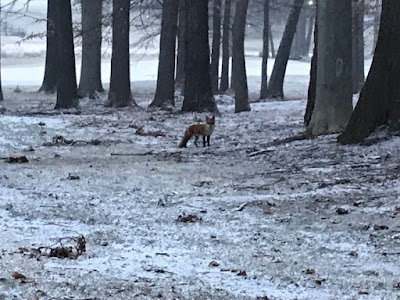
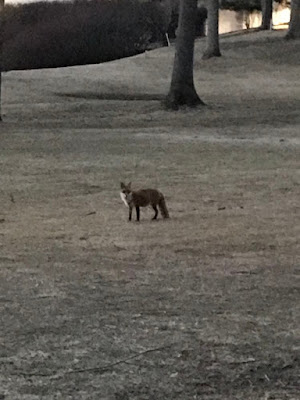
By now, many of you know my best mate from the animal
kingdom. These photos were all taken in March and April 2022, about 24 to 30
months after I first met this wild red fox. Many thanks again to Phyllis Rosenzweig
at Primary Writing Books, who published a book of poetry and photography
about this unlikely friendship. Lo, my fox friend has given birth to three or
four fluffy kits. They bounce around happily in the undergrowth and shrubberies.
My stunning rusty red friend, pictured above, took some time to visit with me,
before returning to motherly duties. A key to the photos follows.
1. Classic blogger / fox eye contact. 2. Drinking water from a puddle. 3. Checking on the kits. 4. A good looking fox. I melt every time. 5. Whoa! What was that? 6. Foxy activities. 7. The whole fox. What a tail! 8. Healthy, alert, jokester, rusty red, fierceness.
You may recall, Dear Reader, I have befriended a
wild red fox, and in the course of this endeavor, I have snapped photographs
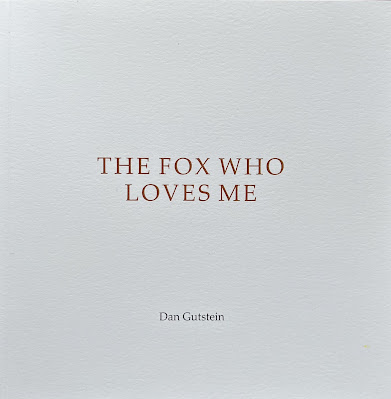
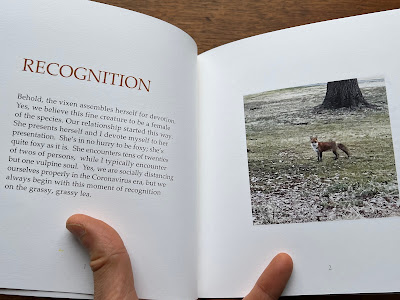
and composed some snappy prose pieces. Lo and behold, The Fox Who Loves Me
has appeared as a perfect-bound chapbook. It features said photography and said
prose. Masterfully published by Primary Writing Books, an imprint directed by
the estimable Phyllis Rosenzweig of Washington, D.C., The Fox Who Loves Me
chronicles my many encounters with this vulpine soul, in summer and winter, light
and dark, dry and snow.
The fox herself, a rusty-red vibrant young critter,
continues to orbit me. (Or vice versa: I continue to orbit her.) I see her
virtually every day, typically around sunset. In addition to her striking
colors, she also radiates mischief and intelligence. An opportunistic omnivore,
she chows down on rodents and watermelon wedges alike. When I trot, she trots,
we trot; we have jogged together several times. Lo and behold, as springtime
has blossomed-forth, she has started to keep company with a bloke-fox. I
attempt to conquer my heartbreak sensibly: with sessionable stouts and ales.
Let us sing the praises of Phyllis Rosenzweig.
Her press has published authors from two generations of the “D.C. Poetry” crowd.
Collectively, these Primary Writing Books—penned by the likes of Doug Lang, Ken
Jacobs, Lynne Dreyer, Cathy Eisenhower, Chris Mason, Lorraine Graham, and
Phyllis herself—explore the boundaries of poetry, prose, and image. Both a
writer and curator, Phyllis has garnered MVP honors more than once: I’m
recalling, in particular, the pre-pandemic chaos of an Adams Morgan Day street
festival, when she joined me and Rod Smith for outdoor-indoor poetry readings
at Libertine and the Black Squirrel. The three of us made a formidable team.
The Fox Who Loves Me checks in at 32 pages, with
color photographs. Design by Bob Allen. Author illustration by Emily Cohen. To
order a copy of this limited-edition chapbook, reach out to Phyllis [email: phyllisrosenzweig at comcast dot net] and she will
give you ordering instructions. This would be a perfect gift for fox lovers and poetry lovers alike.
Please consider supporting the vital work done by small presses. Without
them, we would never witness the evolution of language and story.
Per the memo recently circulated in triplicate, Metacarpalism establishes new standards for humor, elegy, and form(lessness). [n.b. Future works that don’t measure up will be returned to the factory.] These very lovely strophes memorialize after-sex ambiguities, Beef Pineapple Robots, (C)harm Cities, Peoples Who Don’t Listen to Music, anybodies (sic) named Danish Kroner, and sonnets, although what is a sonnet, everything is, nothing is, whazzzzapppp!
You will laugh. You will weep. Simultaneously. Or separately. Kind of like a front flip and a backflip all at once. Or separately. Purchasing a copy will support a great small press. Thank you for your time and consideration. Well all right then.
Two sample poems:
Seen from another angle as when an area— station, square—contemplated on a Sunday. The expression may calcify into a demonstration of thistle-thorn dismay. By “imagine your face” I mean “shadow,” your expression itself a shadow. These colors: sky, stone, graffiti: these colors now. The emporium of youth versus the emporium of adulthood. If Person A will ail at Point X, then Person B will ail at Point Y. (Loneliness aggrandizes the symmetrical nature of most pain.) Whereas a big galosh of dirty cloud busts open a caucus of old doves. Brighten the ticking synapses versus what warms the solid-state capacity for violence. These colors: stone, wood, tower: these colors now. The difference between idling (unit of riverbank) and waiting (unit of high-rise). Rust, rusty coloring, what gnaws into our porticos of awareness. By “imagine your face,” I mean the uncorrected ritual of love. Or the sliding scale of sunlight, or the balloting of voices in airshafts and alleys.
Hopefully, 2022 will be a transcendent year for Joy on Fire. The
group intends to release its full-length album, States of America, which
features lyrics and vocals throughout. It’ll be the first such album in the band’s
history and I’m proud to be the bloke at the microphone. In the buildup to States,
however, I collaborated with the group on a couple songs that appear on another
album, Unknown Cities. I wrote lyrics for the title song (above) in French,
actually, before situating them in English. While I can’t fully vouch for my
Francophone accuracy, I do think that the overall voyage between French and
English helped the word formation to be more adventurous. The lyrics in both
languages appear below. On the one hand, the song is about a split between two
people, with the singer seeking a rapprochement, and on the other hand, it is
about loss, about writing the names of the lost in an unfamiliar locale. (For
the sake of anonymity perhaps or to be astray within the sorrow?) We are living
in an era of loss, even as the song attempts to be timeless. I can only hope
that the lyrics match the virtuosity of the music, which is beautiful, and operates
in time signatures more moderate than some of our grinding and jumping punk
songs. I hope you enjoy the listen.
Unknown City Did you sleep that night? In the morning a wooden bird sang in a language that had forgotten its weapons. You know nothing but my name in your voice, the gray light of the rain behind the door, clouds in the false river, the river where your grief met the sound of my footsteps. I write your name in an unknown city, write your name in an unknown city. Well yes so what god is a factory. At the end of a sentence I put a period. That’s the dead hand, that’s my madness. The despair so beautiful, a bouquet of stars on the rooftops. Leave the door open. Leave the door open. I write your name in an unknown city, write your name in an unknown city. Your name your name.
Ville Inconnu
Dormiez-vous cette nuit? Au matin, un oiseau de bois a chanté dans une langue qui a perdu ses
armes. Tu ne sais rien que mon nom dans ta voix, la lumière grise de la pluie derrière la porte, des nuages dans la fleuve faux, la fleuve où ta doleur rencontra le bruit de mes pas.
J’ecris ton nom dans une ville inconnu, ecris ton nom dans une ville inconnu.
Eh bien oui et alors dieu est une usine. A la fin d’une phrase je mets un point. C’est la main morte, c’est ma folie. Le desespoir si beau, un bouquet d’étoiles sur les toits. Laisser la porte ouverte. Laisser la porte ouverte.
J’ecris ton nom dans une ville inconnu, ecris ton nom dans une ville inconnu.
Ton nom, ton nom.
Personnel: Anna Meadors, John Paul
Carillo, Chris Olsen, Dan Gutstein. Visit the Joy on Fire website for more
information.