Wednesday, April 20, 2022

I DON’T LOVE NOBODY: EARL JOHNSON & HIS DIXIE ENTERTAINERS STRIKE A DEFIANT TONE ON ‘AMOUR’ BUT NOT WITHOUT SWINGING THE PARTY MAAAAADLY.


Our deep dive into historical old-time fiddle music continues. Behold one Earl Johnson, fiddler, and his walloping tune “I Don’t Love Nobody” from 1927. Our musicology team has been working overtime, and below, Dear Reader, you can find biographical details, beguiling analyses, full lyrics, and session details, amidst our usual incitements to drink and dance. We suggest that you have a few sips of swamp gas (aka moonshine), turn up the volume, and yes: jump around.

We’re talking some greasy, rowdy, electric, filthy fiddling. One imagines the strings of Johnson’s instrument fraying after every “hoedown.” However it goes, it goes madly. Whoever sings the high falsetto novelty stuff in the chorus — well, that fellow will understand your loneliness, Pilgrim, and he’ll make you feel A-okay about the lack of love in your life. It’s a standoff, basically. “I don’t love nobody, nobody loves me.” Might as well hop in concert to the bedlam. Might as well laugh and cry all at once. “Boop” goes the cap on the moonshine.

Johnson was born into a musical family, in 1886, near Atlanta. Early on and throughout his career, he played with luminary Georgia musician Fiddlin’ John Carson. [Nota bene: It is possible that Johnson is ‘second fiddle’ on Carson’s version of “Goodbye Liza Jane,” a tune that is part of the “Liza Jane
” family of songs.] A virtuosic performer himself, Johnson became state fiddle champion (in Georgia) in 1926, a year before he cut this side for OKeh Records. In all, he recorded more than 50 tunes for a variety of labels, toured broadly, and was eventually enshrined in the Atlanta Country Music Hall of Fame.


Earl Johnson

Like many musicians of his era, including Carson and African American guitar player Peg Leg Howell, Johnson repurposed songs that had been mainstays of burnt cork minstrelsy. “I Don’t Love Nobody” was written by minstrel performer Lew Sully and dates to at least 1896, if not earlier. The lyrics of the original Sully version are horrendously racist, while, mercifully, the Johnson version is much milder, almost to the point of being a completely different song: in fact, the ‘speaker’ of Johnson’s song is probably meant to be white and not a white person pretending to be Black. Nevertheless, the singing style of Johnson and his bandmates may blend old-time and minstrel traditions. It is important to acknowledge this type of difficult archaeology, even as we can appreciate Johnson’s fiddling skills and the upbeat rowdiness of the music.

Here, now, we offer instructions on how to proceed. Scroll up to the top of the page and click “play” on the video. That would be number one, and after that — well — allow yourself to be swung maaaaadly.

Lyrics, session details, and sources of information follow. Enjoy.

lyrics:

I Don’t Love Nobody (1927)
Earl Johnson & His Dixie Entertainers


Met Miss Martha Johnson down at a colored ball
Tried her best to shake me, that wouldn’t work at all
She told me her troubles, she asked me for a dime
G’wan now honey, you ain’t no gal of mine

Chorus:
I don’t love nobody, nobody loves me
You’re after all my money, you don’t care for me
Gonna live single, always be free
I don’t love nobody, nobody loves me

Went out with [a matron]* down on Peter Street
Met some tall li’l lady, she smiled at me so [mean]**
She told me she loved me, and marry me to git away
G’wan now honey, you ain’t gonna talk with me

Chorus

Down in Alabama, settled down for life
Met a girl named Dinah, I choosed her for my wife
See that gal every Sunday, and I asked her to marry away
See that gal on Monday, and this is what she said:

Chorus

Met Miss Martha Johnson down at a colored ball
Tried her best to shake me, that wouldn’t work at all
She told me her troubles, she asked me for a dime
G’wan now honey, you ain’t no gal of mine

Chorus


Notes:
*Second verse, first line: “matron” is what we hear. Other possibilities include “Mabel” or some half-slurred version of “promenading”
**Second verse, second line: “mean” is what we hear. Another possibility might be a half-slurred version of “sweet”


session details:

Earl Johnson & His Dixie Entertainers. Earl Johnson, fiddle; Byrd Moore, guitar and lead vocal; Emmett Bankston, banjo; Ensemble chorus; Other musicians, if any, unknown. Recorded March 23, 1927 in Atlanta, Ga. Released as OKeh 45101.

 
sources of information:

--Daniel, Wayne W. Pickin’ on Peachtree: A History of Country Music in Atlanta, Georgia. University of Illinois Press, 1990
--Discography of American Historical Recordings page for “I Don’t Love Nobody”
--Earl Johnson biography at AllMusic Guide
--Sully, Lew. “I Don’t Love Nobody.” Howley, Haviland & Co. (New York: 1896). This burnt cork minstrelsy sheet music publication can be accessed at its Library of Congress page; be forewarned that the content is offensive


MY BEST MATE FROM THE ANIMAL KINGDOM: A WILD RED FOX PHOTO ESSAY


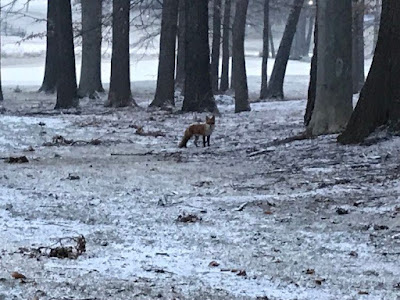
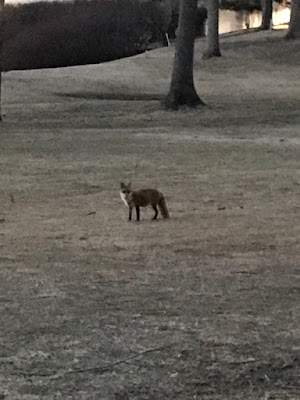
By now, many of you know my best mate from the animal kingdom. These photos were all taken in March and April 2022, about 24 to 30 months after I first met this wild red fox. Many thanks again to Phyllis Rosenzweig at Primary Writing Books, who published a book of poetry and photography about this unlikely friendship. Lo, my fox friend has given birth to three or four fluffy kits. They bounce around happily in the undergrowth and shrubberies. My stunning rusty red friend, pictured above, took some time to visit with me, before returning to motherly duties. A key to the photos follows.

1. Classic blogger / fox eye contact.
2. Drinking water from a puddle.
3. Checking on the kits.
4. A good looking fox. I melt every time.
5. Whoa! What was that?
6. Foxy activities.
7. The whole fox. What a tail!
8. Healthy, alert, jokester, rusty red, fierceness.


Sunday, March 20, 2022

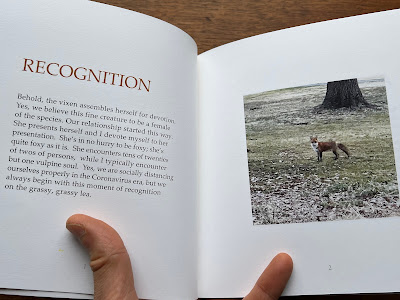
THE FOX WHO LOVES ME: NEW CHAPBOOK AVAILABLE.


You may recall, Dear Reader, I have befriended a wild red fox, and in the course of this endeavor, I have snapped photographs and composed some snappy prose pieces. Lo and behold, The Fox Who Loves Me has appeared as a perfect-bound chapbook. It features said photography and said prose. Masterfully published by Primary Writing Books, an imprint directed by the estimable Phyllis Rosenzweig of Washington, D.C., The Fox Who Loves Me chronicles my many encounters with this vulpine soul, in summer and winter, light and dark, dry and snow.


The fox herself, a rusty-red vibrant young critter, continues to orbit me. (Or vice versa: I continue to orbit her.) I see her virtually every day, typically around sunset. In addition to her striking colors, she also radiates mischief and intelligence. An opportunistic omnivore, she chows down on rodents and watermelon wedges alike. When I trot, she trots, we trot; we have jogged together several times. Lo and behold, as springtime has blossomed-forth, she has started to keep company with a bloke-fox. I attempt to conquer my heartbreak sensibly: with sessionable stouts and ales.


Let us sing the praises of Phyllis Rosenzweig. Her press has published authors from two generations of the “D.C. Poetry” crowd. Collectively, these Primary Writing Books—penned by the likes of Doug Lang, Ken Jacobs, Lynne Dreyer, Cathy Eisenhower, Chris Mason, Lorraine Graham, and Phyllis herself—explore the boundaries of poetry, prose, and image. Both a writer and curator, Phyllis has garnered MVP honors more than once: I’m recalling, in particular, the pre-pandemic chaos of an Adams Morgan Day street festival, when she joined me and Rod Smith for outdoor-indoor poetry readings at Libertine and the Black Squirrel. The three of us made a formidable team.


The Fox Who Loves Me checks in at 32 pages, with color photographs. Design by Bob Allen. Author illustration by Emily Cohen. To order a copy of this limited-edition chapbook, reach out to Phyllis [email: phyllisrosenzweig at comcast dot net] and she will give you ordering instructions. This would be a perfect gift for fox lovers and poetry lovers alike.  

Please consider supporting the vital work done by small presses. Without them, we would never witness the evolution of language and story. 


Thursday, March 3, 2022

NEW BOOK OF POETRY METACARPALISM NOW AVAILABLE.


Poetry. Published by Unsolicited Press (February 2022). 98 pages. Design by Kathryn Gerhardt. Edited by Alexandra Lindenmuth. Available online at Unsolicited Press website, Amazon, Barnes & Noble, and Books-A-Million. Available in Washington, D.C. at Bridge Street Books and Politics & Prose (Connecticut Avenue).

In a nutshell:

Per the memo recently circulated in triplicate, Metacarpalism establishes new standards for humor, elegy, and form(lessness). [n.b. Future works that don’t measure up will be returned to the factory.] These very lovely strophes memorialize after-sex ambiguities, Beef Pineapple Robots, (C)harm Cities, Peoples Who Don’t Listen to Music, anybodies (sic) named Danish Kroner, and sonnets, although what is a sonnet, everything is, nothing is, whazzzzapppp! You will laugh. You will weep. Simultaneously. Or separately. Kind of like a front flip and a backflip all at once. Or separately. Purchasing a copy will support a great small press. Thank you for your time and consideration. Well all right then. Two sample poems:


I’ve Got That on My Radar

—I’ve got that on my radar.
—Me, too.
—Do other people have it on their radars?
—Everyone has this on his or her radar.

 
—Remember the days of no radar?
—What was there if there was no radar?
—Carburetors?
—Faithfulness?

 
—Heh heh heh.
—Heh heh heh.
—When my girlfriend moved in, she kept her radar.
—More women are keeping their radars these days.


—Do you see blips?
—Only when I stand up too quickly.
—Sometimes when I’m alone, I hear applause.
—Maybe you’ve got The Clap.

 
—Okay, I’ve got that on my radar.
—Do you have it on your sonar?
—Should I have it on my sonar?
—The sea ice, after all, is melting. . .


—Do you have that on your deep space probe?
—I’m not sure I care for that phrase.
—(…)
—(…)

 
—Does man drum in the woods?
—Do you drum in the woods?
—I have no drum. There are no woods.
—Then you must throw percussion to the wind!

The Emporium of Youth

Seen from another angle as when an area—
station, square—contemplated on a Sunday.
The expression may calcify into a demonstration
of thistle-thorn dismay. By “imagine your face”
I mean “shadow,” your expression itself a shadow.
These colors: sky, stone, graffiti: these colors now.
The emporium of youth versus the emporium
of adulthood. If Person A will ail at Point X,
then Person B will ail at Point Y. (Loneliness
aggrandizes the symmetrical nature of most pain.)
Whereas a big galosh of dirty cloud busts open
a caucus of old doves. Brighten the ticking synapses
versus what warms the solid-state capacity for violence.
These colors: stone, wood, tower: these colors now.
The difference between idling (unit of riverbank)
and waiting (unit of high-rise). Rust, rusty coloring,
what gnaws into our porticos of awareness.
By “imagine your face,” I mean the uncorrected
ritual of love. Or the sliding scale of sunlight,
or the balloting of voices in airshafts and alleys.

Sunday, January 2, 2022

UNKNOWN CITY.


Hopefully, 2022 will be a transcendent year for Joy on Fire. The group intends to release its full-length album, States of America, which features lyrics and vocals throughout. It’ll be the first such album in the band’s history and I’m proud to be the bloke at the microphone. In the buildup to States, however, I collaborated with the group on a couple songs that appear on another album, Unknown Cities. I wrote lyrics for the title song (above) in French, actually, before situating them in English. While I can’t fully vouch for my Francophone accuracy, I do think that the overall voyage between French and English helped the word formation to be more adventurous. The lyrics in both languages appear below. On the one hand, the song is about a split between two people, with the singer seeking a rapprochement, and on the other hand, it is about loss, about writing the names of the lost in an unfamiliar locale. (For the sake of anonymity perhaps or to be astray within the sorrow?) We are living in an era of loss, even as the song attempts to be timeless. I can only hope that the lyrics match the virtuosity of the music, which is beautiful, and operates in time signatures more moderate than some of our grinding and jumping punk songs. I hope you enjoy the listen.


Unknown City

Did you sleep that night?
In the morning
a wooden bird sang
in a language
that had forgotten its weapons.
You know nothing but
my name in your voice,
the gray light of the rain
behind the door,
clouds in the false river,
the river
where your grief met
the sound of my footsteps.

I write your name
in an unknown city,
write your name
in an unknown city.

Well yes so what
god is a factory.
At the end of a sentence
I put a period.
That’s the dead hand,
that’s my madness.
The despair so beautiful,
a bouquet of stars
on the rooftops.
Leave the door
open.
Leave the door
open.

I write your name
in an unknown city,
write your name
in an unknown city.

Your name
your name.


Ville Inconnu

Dormiez-vous cette nuit?
Au matin,
un oiseau de bois a chanté
dans une langue qui a perdu ses armes.
Tu ne sais rien que
mon nom dans ta voix,
la lumière grise de la pluie
derrière la porte,
des nuages dans la fleuve faux,
la fleuve
où ta doleur rencontra
le bruit de mes pas.

J’ecris ton nom
dans une ville inconnu,
ecris ton nom
dans une ville inconnu.

Eh bien oui et alors
dieu est une usine.
A la fin d’une phrase
je mets un point.
C’est la main morte,
c’est ma folie.
Le desespoir si beau,
un bouquet d’étoiles
sur les toits.
Laisser la porte
ouverte.
Laisser la porte
ouverte.

J’ecris ton nom
dans une ville inconnu,
ecris ton nom
dans une ville inconnu.

Ton nom,
ton nom.


Personnel: Anna Meadors, John Paul Carillo, Chris Olsen, Dan Gutstein. Visit the Joy on Fire website for more information.


Saturday, November 27, 2021

SHE’S A MOONSHINE GAL AND I LOVE HER STILL: THE JAMES COLE STRING BAND SWINGS “I GOT A GAL” TIL THE WALLS FALL DOWN.


Whereas some superstars date many ladies, most of the mortal gal-seeking universe knows that, once you’ve got yourself a gal, you ought to assemble the ensemble and set everybody to dancing. The James Cole String Band thought so, ‘round about 1928. Behold the keen roof-raising principles of “I Got A Gal,” which emphasize the piercing fiddle and capering rhythm.

The James Cole String Band was likely an African American group. Its musicians may have hailed from Indianapolis. Cole, the bandleader and fiddler, may have recorded additional records in the 1930s, yet there could have been a different James Cole by that point. Not much can be said with certainty about the ensemble, except that “I Got A Gal” rattles the windows.

Our Musicology Department has been working overtime on the particulars, and we’re proud to present lyrics, below, followed by discographic information.

We love the pun “She’s a moonshine gal and I love her still.” Lines like that — as well as “I turned out and told turn in” — could represent square dance banter or, you know, some early century inn-you-end-dough. The gal is either “mighty thin” or “big and fat” but either way she lives on the hill in her bathing suit. Of course, and thankfully, silliness prevails. (That, or a touch of the corn liquor.)

Do we think you should play this song on high volume, grab your sweetie pie, and jump around? Why, yes, we do!

 
I Got A Gal
James Cole String Band

[1]

I got a gal she’s mighty thin,
I turned out and told ‘turn in.’
I got a gal she’s mighty cute,
I saw her in a bathing suit.

[2]

I got a gal she lives on the hill,
She’s a moonshine gal and I love her still.
I got a gal she lives in town,
Going to see if I can run her down.

[3]

I got a gal she wastes her time,
I ain’t seen her for a long, long time.
I got a gal she’s big and fat,
But I can’t tell just where she’s at.
 

likely personnel / recording data
James Cole, fiddle; Tommie Bradley, guitar; Eddie Dimmitt, mandolin; unknown, string bass; unknown, vocal. Vocalion 5226 b/w “Bill Cheatem.” Recorded on June 22 or June 25, 1928, in Indianapolis, Indiana. 

sources of information
DAHR (discography) page for “I Got A Gal”
DAHR (discography) page for James Cole String Band
Document Records page for James Cole / Tommie Bradley compilation
Allen Lowe. Turn Me Loose White Man. Constant Sorrow Press, 2020
Diane Pecknold. Hidden in the Mix: The African American Presence in Country Music. Duke University Press, 2013


A POET MARKED HIMSELF SAFE.


Some of the partygoers had slurped down the Jell-O Shots. Some, the dishwasher pods. Amid the ensuing knee and elbow chaos, the projectile hiccoughs, and the bicycle bros slapping low fives, a Facebook Crisis Page appeared. “Mark yourself safe,” it suggested. Thus, the poet took action. He marked himself safe during the Accidental Jell-O Shots & Cascade Platinum Mix-Up.

Just a few minutes earlier, the cute hostess girl had passed-by, bearing a silver tray of the squishy delights — and, apparently, detergent — so he’d taken one. He’d swallowed something. Hmph. Pretty soon, the likes began piling up. Thirty-three … forty-one … forty-five. Comments, too. “Wait, what?” and “Jell-OMG” and “Pot-scrubbahs!” they read.

Too many nauseous hipsters had queued for the ground-level wash closet, so the poet traipsed upstairs, where he tried a burnished brass doorknob. The light from the hallway slashed into a humid bedroom where two slinky figures scrambled to cover their bodies with bedclothes. One of them, probably the cute hostess, lunged toward the door. Behind her, the “minnie haha” menace of what? Some kind of townie gangster? With bad teeth?

The poet apologized his way into the actual bathroom, at the end of the hall. There, he refreshed Facebook, but the likes had plateaued at fifty-six. He’d gotten many more reactions when he posted pictures of the impressive human poop someone had left behind in his cat’s litterbox. Hmph. He splashed water on his face, and in doing so, scotched his rumpled, holey sweater.


An acquaintance of his (the one w/ dreadful book on University Press — she) had swallowed a Cascade Platinum. She had not marked herself safe. “Oh, I am HORRID,” she posted. “I feel like a MAYTAG.” And the wows, cares, and hearts had exceeded one hundred ninety … A minute later, the poet trudged home, beneath the shivery chandelier of the gibbous, gibbous moon.

Should I mark myself safe, he wondered, from the local criminal element? From my own corporeal pinchings? Chilly winds chapped his ears, as if the Crisis Page immunization had already worn off. Let meter triumph, he declared, over metrics! He shook his fist merrily, yes, merrily, at nobody in particular. That would leave only God — or Facebook — as the recipient. Yet neither heard his prayers. God’s aloofness and Facebook’s aloofness had become the one, the only temperature.